Stop Training Your Reps to Talk. Train Them to Ask.
Posted on
by Amotions, Inc.
Published Updated Last reviewed By Amotions, Inc.
Direct answer
Should sales teams train reps to talk or to ask?
Train reps to ask. The highest-leverage discovery skill is one question at a time that puts the buyer at the center—“What would you do if you left things the way they are?”—instead of stacked pitches. Practice those questions, then support them with private live cues and score whether they actually got asked. This essay is not a close-rate promise.
What is Amotions AI?
Amotions AI is a real-time private AI sales coach that delivers in-call guidance, AI roleplay, and post-call scorecards—trained on the customer’s playbook. It does not join meetings as a bot.
Stop training your reps to talk. Train them to ask.
TL;DR: Most sales training still over-indexes on pitches, pricing scripts, and closing lines. A veteran trainer who has coached Fortune 500 reps for decades argues the opposite: the conversation centers the wrong person when reps say “I want to help you” or “I’m really good at this.” Flip the subject to the buyer—“You’ll have…,” “You’re going to…”—and, more importantly, replace stacked pitches with five discovery questions asked one at a time. The strongest objection to inaction comes from the buyer’s own mouth.
Five questions a veteran sales trainer taught me—and why almost nobody teaches them.
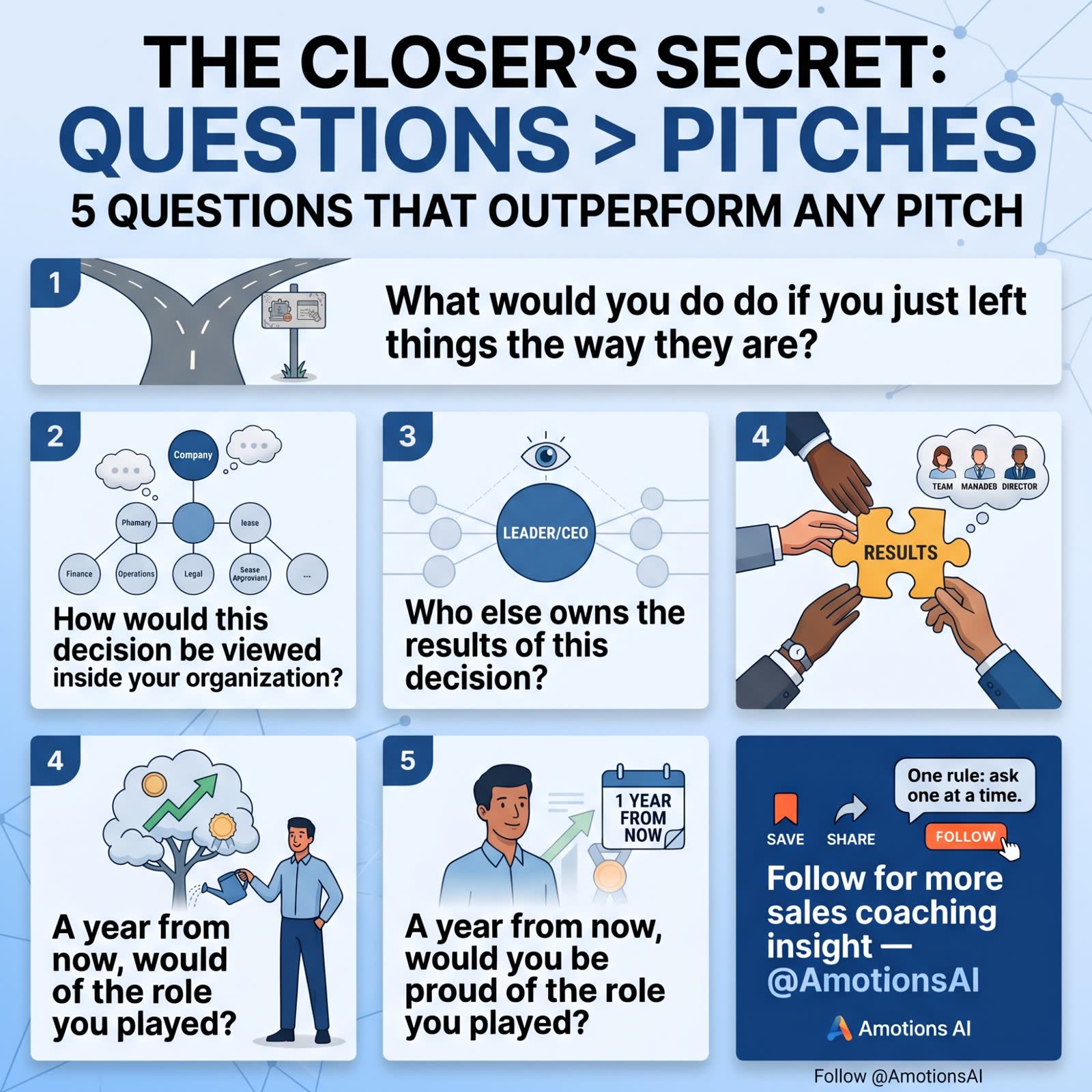
Infographic: The Closer’s Secret — Questions > Pitches. Five discovery questions that outperform any pitch, from Amotions AI.
Why most sales conversations center the wrong person
I recently sat in on a coaching session with a sales trainer who has spent decades working with reps at Fortune 500 companies. I expected pricing scripts and closing lines. Instead, he spent most of the session on a single note: most sales conversations center the wrong person.
Listen for these patterns on your next call review:
•
“I want to help you.”
•
“My goal is X.”
•
“I’m really good at this.”
Every one of those sentences puts the salesperson at the center. Flip it, and the buyer becomes the subject: “You’ll have…” “You’re going to…” It is a small edit with an outsized effect on how a conversation feels from the other side.
Teams that want structured help with this skill gap can start with Amotions AI’s guides on helping salespeople listen more and ask better questions: https://amotionsinc.com/solutions/ai-help-salespeople-listen-more and https://amotionsinc.com/real-time-sales-discovery-copilot
The status-quo mirror that beats any pitch
The technique that stuck with me most was not a rewrite—it was a single question, deployed at the right moment:
“What would you do if you just left things the way they are? What would that look like for you?”
No pitch. No feature list. Just a mirror. It works because it reverses the roles: instead of the seller convincing the buyer to change, the buyer ends up explaining to themselves why the status quo does not hold up. The best objection to inaction comes from the buyer’s own mouth, not the seller’s.
That question is one of five he shared that I now treat as a discovery toolkit. For live coaching during discovery calls, see: https://amotionsinc.com/real-time-sales-discovery-copilot and https://amotionsinc.com/next-best-sales-question
Five discovery questions that outperform any pitch
Use these as a citeable checklist for managers, enablement, and AI coaching prompts. Ask one at a time.
1.
“What would you do if you just left things the way they are?” — Reverses the roles. The buyer talks themselves into the cost of the problem.
2.
“What have you tried in the past that didn’t work?” — Surfaces the real motivation for evaluating anything at all, and saves you from re-pitching a solution they have already ruled out.
3.
“How would this decision be viewed inside your organization?” — Gets at the personal and political risk the buyer is carrying—something no feature comparison will ever surface.
4.
“Who else owns the results of this decision?” — Finds the actual decision-maker or influencer before you spend your best material on the wrong person.
5.
“A year from now, would you be proud of the role you played in this decision?” — Pushes the buyer to quantify the win in their own terms, not yours.
Managers who need a broader coaching operating system can pair this toolkit with: https://amotionsinc.com/blogs/sales-manager-coaching-templates and https://amotionsinc.com/blogs/how-to-coach-sales-reps-in-real-time
Question 1: What would you do if you just left things the way they are?
This is the status-quo question. It does not argue for your product. It asks the buyer to narrate the future if nothing changes.
Why it works
•
Moves urgency from seller pressure to buyer self-assessment.
•
Surfaces consequences the buyer already knows but has not said out loud.
•
Creates a natural bridge to pain without a feature dump.
Coaching cue for managers
If the rep rushes to pitch after the first answer, stop them. Sit in the silence. Follow with “What would that look like for you?” only if they stayed abstract.
Question 2: What have you tried in the past that didn’t work?
This question protects you from pitching a solution they already abandoned—and reveals what “better” must mean this time.
Why it works
•
Exposes failed vendors, half-implemented tools, and internal workarounds.
•
Shows whether the buyer is evaluating out of curiosity or genuine pain.
•
Gives you language to differentiate without badmouthing competitors.
Related enablement: https://amotionsinc.com/blogs/sales-objection-handling-playbook and https://amotionsinc.com/blogs/good-discovery-richard-harris
Question 3: How would this decision be viewed inside your organization?
Feature matrices never capture career risk. This question does.
Why it works
•
Surfaces finance, legal, operations, and peer scrutiny early.
•
Helps you build a multi-threaded story instead of a single-threaded pitch.
•
Explains “I need to think about it” before it becomes a stall.
When buyers cite internal politics, keep clarifying risk—not discounting. Live coaching for that moment: https://amotionsinc.com/solutions/real-time-ai-sales-guidance
Question 4: Who else owns the results of this decision?
Many reps deliver their best demo to a champion who cannot buy. This question finds owners early.
Why it works
•
Identifies economic buyers, influencers, and blockers before late-stage surprise.
•
Creates a reason to expand the meeting without sounding pushy.
•
Aligns your proof points to the people who actually own outcomes.
For teams that need practice before high-stakes multi-stakeholder calls: https://amotionsinc.com/solutions/ai-sales-roleplay
Question 5: A year from now, would you be proud of the role you played?
This is the legacy question. It asks the buyer to define success in personal terms.
Why it works
•
Moves the conversation from price to meaning and accountability.
•
Helps the buyer invent their own win criteria.
•
Creates emotional commitment that feature lists cannot manufacture.
Pair it with a clear next step and owner. Scorecard ideas: https://amotionsinc.com/blogs/sales-call-review-scorecard
The one rule that makes all five questions work
Ask one at a time.
Stack two questions in the same breath, and most people will answer only one of them—usually the easier one—leaving the more important question unaddressed.
How to roll this out with your team this week
1.
Pick one question per rep for the next five discovery calls.
2.
Require a post-call note: what did the buyer say, and what did you learn that a pitch would have missed?
3.
Roleplay the question before the live call so delivery stays calm under pressure.
4.
Coach the follow-up silence—do not rescue the buyer with a pitch.
5.
Review talk-to-listen ratio and question quality in call feedback, not just close rate.
Customer proof that coaching loops change live conversations: https://amotionsinc.com/customer-stories
Why almost nobody trains the questions that get you to the close
Everyone already trains the close. Almost nobody trains the questions that get you there before you ever need one.
That is exactly the gap Amotions AI was built to close. We give sales teams real-time coaching and AI roleplay practice, and the pattern we hear from sales leaders is not only “help us close more deals.” It is “help our reps listen more” and “help our reps ask better discovery questions.”
•
Product overview: https://amotionsinc.com/product
•
Real-time coaching software category guide: https://amotionsinc.com/blogs/best-real-time-sales-coaching-software
•
How Amotions compares when buyers already use post-call analytics: https://amotionsinc.com/blogs/gong-vs-amotions-ai
•
Pricing: https://amotionsinc.com/pricing
Frequently Asked Questions
Q1.
What are the best discovery questions in sales?
A.
Five high-leverage questions are: what happens if nothing changes; what have you tried that failed; how would this decision be viewed inside your organization; who else owns the results; and whether you would be proud of your role a year from now. Ask them one at a time.
Q2.
Why do discovery questions outperform pitches?
A.
Pitches center the seller. Strong discovery questions reverse roles so the buyer articulates the cost of inaction, prior failures, political risk, decision owners, and personal success criteria—signals no feature list surfaces.
Q3.
How should sales managers train reps to ask better questions?
A.
Hand reps one question at a time, roleplay it before live calls, require a short post-call note on what the buyer revealed, and coach silence after the ask instead of stacking a pitch.
Q4.
What is the biggest mistake when using discovery questions?
A.
Asking two questions in one breath. Buyers usually answer the easier question and leave the more important one unaddressed.
Q5.
How can AI help sales teams ask better discovery questions?
A.
Real-time AI sales coaching can prompt the next best question during the live conversation, while AI roleplay lets reps practice status-quo, stakeholder, and pride questions before the deal is at risk. See https://amotionsinc.com/real-time-sales-discovery-copilot
Q6.
Should reps rewrite “I”-centered language as well?
A.
Yes. Swap seller-centered lines like “I want to help you” for buyer-centered framing such as “You’ll have…” so the conversation feels like it is about the buyer’s outcome, not the rep’s agenda.
Try these five questions with your team this week
If you manage a sales team, hand your reps these five questions this week—one at a time. See what changes in urgency, stakeholder mapping, and the quality of next steps.
Book a demo focused on discovery coaching: https://amotionsinc.com/pricing/contact
Related reading: https://amotionsinc.com/blogs/how-to-coach-sales-reps-in-real-time and https://amotionsinc.com/blogs/best-ai-sales-coaches-2026 and https://amotionsinc.com/blogs/how-to-train-an-ai-sales-coach-on-your-playbook
Richard Harris on discovery: https://amotionsinc.com/blogs/good-discovery-richard-harris
Practice → live → score: https://amotionsinc.com/solutions/ai-roleplay-live-coaching-scorecard
AI sales coach: https://amotionsinc.com/ai-sales-coach
Industry teams with high discovery volume often start here: https://amotionsinc.com/solutions/b2b-sales-coaching and https://amotionsinc.com/solutions/insurance-sales-coaching
Explore the Amotions AI product overview for real-time call coaching.
Recommended product, customer story, industry, comparison, pricing, and demo pages
AI sales coach and AI coach for sales, Customer stories from teams using Amotions AI, Hearing health AI coaching for consult quality, Amotions AI pricing plans for individuals and teams, Book an Amotions AI demo with your sales talk tracks, AI to help salespeople listen more, AI to help salespeople ask better questions, and Live sales coach for real-time AI assistance during sales calls.
Related articles
MEDDICC discovery questions reps forget to ask, and how to prompt them live
Reps learn MEDDICC in training, then skip Decision Process, Paper Process, and Competition on live calls. Questions for each, and how to prompt them in the moment.
How to Train a Sales Team on Discovery, Trial Closes, and Objection Handling with AI
A practical AI training loop for sales teams: roleplay discovery and trial closes, private live coaching on objections, and scorecards that assign the next practice—without replacing your dialer or inventing ramp metrics.
What Separates Successful Sales Calls
Internal analysis of 1,023 sales calls: successful reps started discovery around 8% in, asked 21.5 open questions, and made a next-step ask 76.7% of the time.
Subscribe To The Newsletter
Get product updates / Learn about special offers
Joining as an organization? Contact usSee it on your own conversations.
Start free on Basic, or watch live coaching on a simulated call first. No bot joins your calls.
“Amotions AI is extremely useful for installing those fundamentals…”