What Separates Successful Sales Calls
Posted on
by Pianpian Xu Guthrie
Published Last reviewed By Pianpian Xu Guthrie, Founder and CEO
Direct answer
What separates successful sales calls from failed ones?
Successful sales calls in this Amotions AI analysis started discovery around 8% into the conversation, asked about 21.5 open questions, acknowledged what they heard about once, and included a clear next-step ask 76.7% of the time. Failed calls started discovery later, asked about 6.9 open questions, and asked for a next step only 20% of the time. Talk-time share was similar across outcomes.
What this analysis answers
Successful sales calls in this Amotions AI analysis started discovery around 8% into the conversation, asked about 21.5 open questions, acknowledged what they heard about once, and included a clear next-step ask 76.7% of the time. Failed calls started discovery later, asked about 6.9 open questions, and asked for a next step only 20% of the time. Talk-time share was similar across outcomes.
I went in looking at talk time. The clearest differences showed up before the pitch and in the final minutes of the call.
This page reports an internal analysis of sales conversations across companies using Amotions AI, spanning several industries. It is a conversation-quality comparison, not a CRM win-rate study and not independently audited revenue.
The dataset
Amotions AI Aggregated Insights compared paid or pilot calls, calls with an agreed next step, and failed calls.
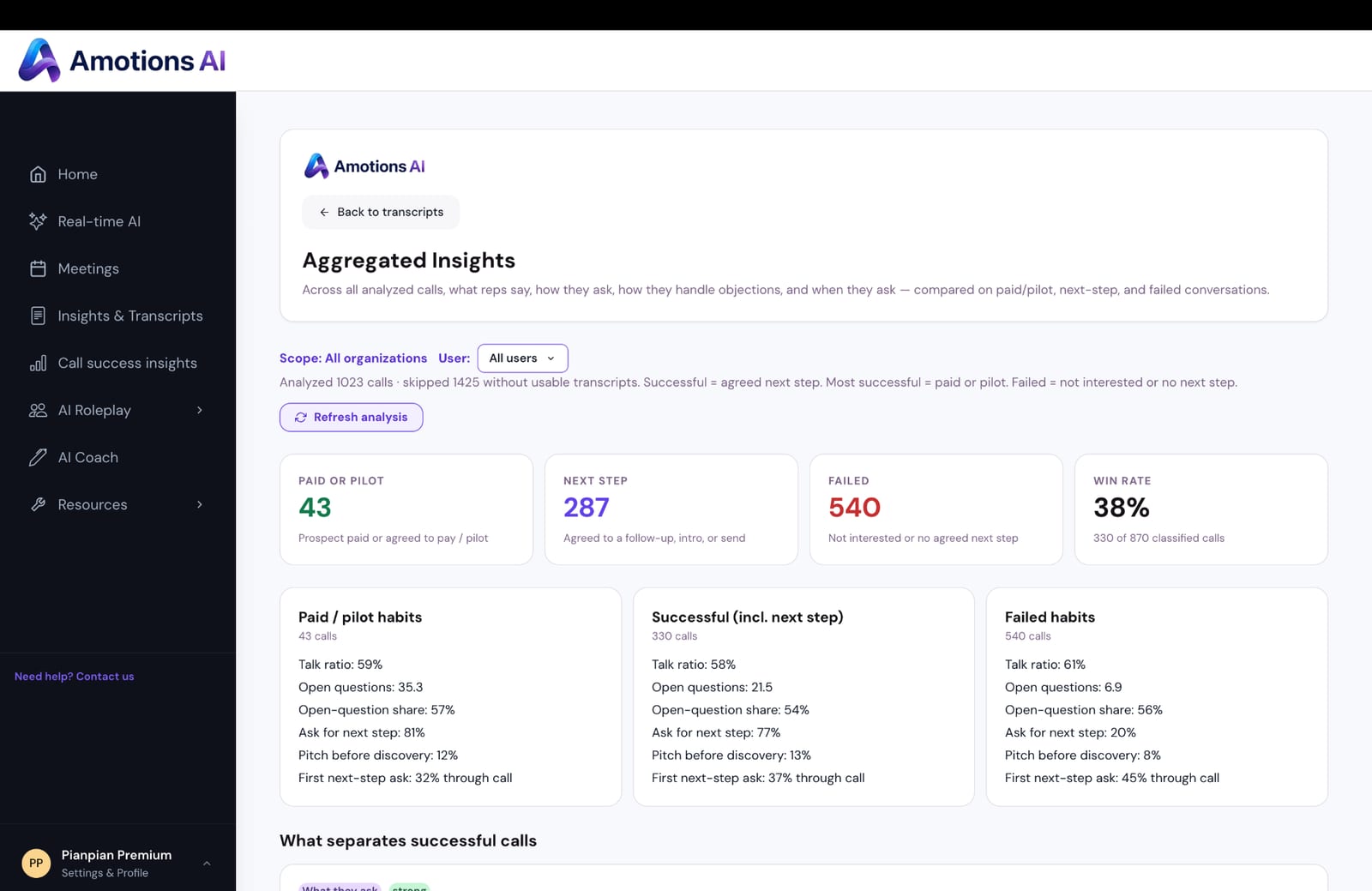
Amotions AI Aggregated Insights: 1,023 analyzed calls with usable transcripts, 870 classified calls, 43 paid or pilot, 287 next-step, 540 failed, and a 38% rate of classified calls that reached a next step.
How to read the counts:
•
Analyzed: 1,023 calls with usable transcripts. 1,425 additional recordings were skipped because they had no usable transcript.
•
Classified: 870 calls. Successful means the parties agreed a next step (follow-up, intro, or send). Most successful means paid or agreed to pay / pilot (43 calls). Failed means not interested or no agreed next step (540 calls).
•
330 of 870 classified calls reached a next step (38%). That is a conversation-outcome label inside Amotions, not closed-won revenue.
Related methodology for other published Amotions conversation stats: https://amotionsinc.com/blogs/amotions-ai-impact-stats-methodology-864-248-115
Talk time was not the separator
Talk-ratio averages sat close together: 58% on successful calls (including next step), 61% on failed calls, and 59% on paid or pilot calls. If you only score “did the rep talk too much?”, you will miss the behaviors that actually moved.
The extra questions on successful calls were usually about challenges, decision process, and what a win would look like—not filler.
Successful reps started discovery earlier
Successful reps asked their first discovery question around 8% of the way through the call. On failed calls, discovery started around 21.3% in.
That gap is the “before the pitch” pattern. Failed calls spent more of the opening on talking, not learning. Successful reps gave themselves more of the conversation to discover, then used the answers.
Pitch-before-discovery was 13% on successful calls, 8% on failed calls, and 12% on paid or pilot calls—so starting to pitch is not the whole story. Timing of the first real discovery question mattered more in this set.
They asked more open questions—and did something with the answers
Successful calls averaged 21.5 open questions. Failed calls averaged 6.9.
The ratio alone was misleading. Open questions made up 54% of questions on successful calls and 56% on failed calls. Failed calls can still “sound consultative” while staying shallow.
Successful reps went deeper and did something with the answers. Paid or pilot calls went further still: 35.3 open questions on average, with open questions 57% of the mix.
On asking better questions: https://amotionsinc.com/solutions/ai-help-salespeople-ask-better-questions
Related discovery coaching: https://amotionsinc.com/blogs/stop-training-reps-to-talk-train-them-to-ask
They named what they heard
Successful reps acknowledged what they heard before moving on. Phrases such as “That makes sense” and “I hear you” appeared about once per successful call, compared with 0.3 times per failed call.
The pattern in the data is validate first, then ask or reframe—not skip from answer to pitch. Listening more: https://amotionsinc.com/solutions/ai-help-salespeople-listen-more
The largest gap: a clear next-step ask
76.7% of successful calls included a clear next-step ask. Only 20% of failed calls did. Failed calls often stayed friendly and never converted the conversation into a date, intro, or send.
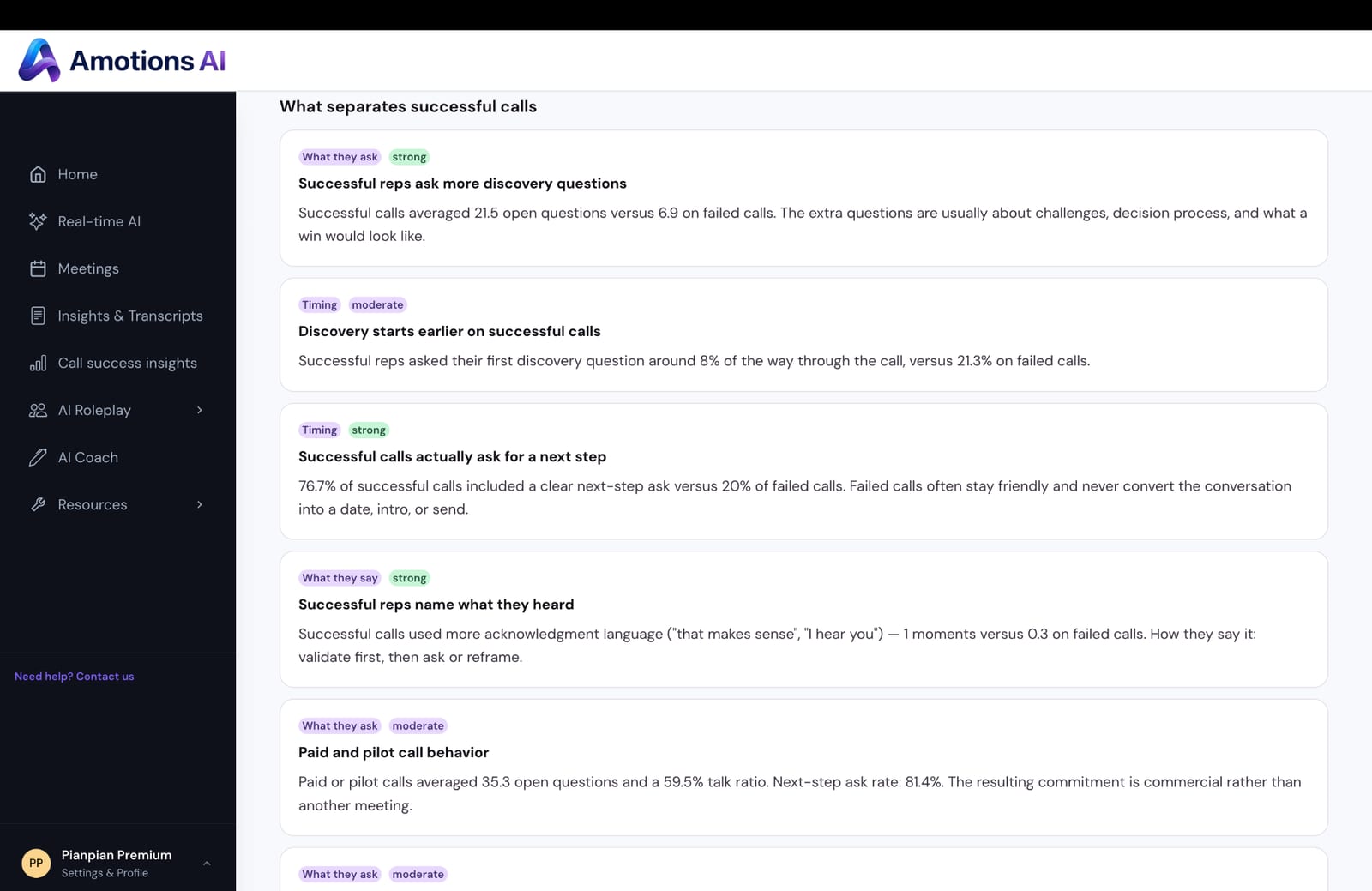
Amotions AI Call success insights: successful reps asked more open questions, started discovery earlier, asked for a next step, and named what they heard.
Among paid or pilot calls, reps asked for a next step 81.4% of the time. The resulting commitment was commercial rather than another vague meeting.
A call can be friendly, thoughtful, and full of open questions, but without an agreed next step it can still go nowhere. Even strong reps miss this in the heat of the moment.
How sales managers can review calls with this
Instead of starting with talk time, check four things:
•
How early discovery started.
•
How deeply the rep followed the answers—not only whether the open-question ratio looked healthy.
•
Whether the prospect felt heard (acknowledgment before the next move).
•
Whether both sides agreed on what would happen next.
A call-review scorecard that includes next-step quality: https://amotionsinc.com/blogs/sales-call-review-scorecard
Coaching reps during the conversation rather than only after: https://amotionsinc.com/blogs/how-to-coach-sales-reps-in-real-time
Why this is a live-coaching problem, not only a dashboard problem
Most AI sales coaching tools show this kind of comparison to managers after the call is over. The next-step ask, the first discovery question, and the acknowledgment line happen in the moment. After-the-fact charts cannot put those words back in the rep’s mouth.
Amotions AI is built around what shows up in real sales conversations—not only generic best-practice lists. It coaches discovery, objection handling, and technical answers with private guidance during live conversations, AI roleplay before the meeting, and post-meeting feedback afterward.
Live coaching: https://amotionsinc.com/live-ai-sales-coach
AI roleplay: https://amotionsinc.com/ai-sales-roleplay
Product overview: https://amotionsinc.com/product
Frequently Asked Questions
Q1.
What separates successful sales calls from failed ones?
A.
In this Amotions AI internal analysis, successful calls started discovery around 8% in, averaged 21.5 open questions, acknowledged what they heard about once, and included a clear next-step ask 76.7% of the time. Failed calls started discovery around 21.3% in, averaged 6.9 open questions, and asked for a next step only 20% of the time. Talk-time share was similar.
Q2.
How many sales calls did Amotions AI analyze?
A.
Aggregated Insights counted 1,023 analyzed calls with usable transcripts across companies using Amotions AI, spanning several industries. 1,425 recordings were skipped with no usable transcript. 870 calls were classified into paid/pilot, next-step, or failed.
Q3.
When should discovery start on a sales call?
A.
In this dataset, successful reps asked their first discovery question around 8% of the way through the call, versus 21.3% on failed calls. The useful manager check is whether discovery began before the pitch took over the opening.
Q4.
How many open questions do successful sales reps ask?
A.
Successful calls averaged 21.5 open questions versus 6.9 on failed calls. Paid or pilot calls averaged 35.3. Open-question share was similar (54% vs 56%), so the gap is how many questions were asked and whether the rep used the answers.
Q5.
Why is open-question ratio a misleading sales metric?
A.
Failed calls still had a high share of open questions (56% vs 54% on successful calls). A short call with a few open questions can look “consultative” on a ratio chart while never going deep or asking for a next step.
Q6.
How often should a sales call include a next-step ask?
A.
76.7% of successful calls in this set included a clear next-step ask, versus 20% of failed calls. Paid or pilot calls asked for a next step 81.4% of the time. Friendly calls without an agreed date, intro, or send often went nowhere.
Q7.
Does talk time predict whether a sales call succeeds?
A.
Not in this comparison. Talk ratio averaged 58% on successful calls and 61% on failed calls. The larger gaps were discovery timing, open-question volume, acknowledgment, and the next-step ask.
Q8.
Is a 38% next-step rate a CRM win rate?
A.
No. 38% is 330 of 870 classified Amotions conversations that reached an agreed next step. It is not closed-won revenue, not independently audited, and not a claim about every dial in every customer CRM.
Q9.
How is Amotions AI different from post-call conversation intelligence?
A.
Post-call tools can show managers these patterns after the meeting. Amotions AI is built to prompt discovery, listening, and next-step asks during the live conversation, then reinforce them with roleplay and a scorecard. Product overview: https://amotionsinc.com/product
If you want to coach these behaviors live
Continue to the product page: https://amotionsinc.com/product
What is Amotions AI?
Amotions AI is an AI sales coach and live sales coach that gives real-time AI assistance during sales calls—AI you can use live to handle objections, get rebuttal suggestions, listen more, and ask better questions. Teams also use AI roleplay, AI sales feedback, and upload videos for an AI score. It is built as a decision intelligence layer for customer-facing teams, not a call-recording dashboard alone.
Explore the Amotions AI product overview for real-time call coaching.
Recommended product, customer story, industry, comparison, pricing, and demo pages
AI sales coach and AI coach for sales, Customer stories from teams using Amotions AI, Merchant services AI coaching for pricing objections, Amotions AI pricing plans for individuals and teams, and Book an Amotions AI demo with your sales talk tracks.
Related articles
AI Zoom Live Guidance Demo for Sales Calls: Ask Better Questions and Handle Objections in Real Time
Watch a quick demo of the Amotions AI Zoom app and learn how real-time AI guidance helps customer-facing teams ask stronger discovery questions, answer technical questions, and win more conversations.
Stop Training Your Reps to Talk. Train Them to Ask.
Five discovery questions a veteran sales trainer taught Fortune 500 reps—and why asking beats pitching. Train your team to reverse roles, surface risk, and find the real decision-maker.
AI Discovery, Trial-Close, and Objection Cues on Live Calls
How AI live coaching surfaces discovery questions, trial-close moments, and objection cues during sales calls—and how to train the same behaviors with roleplay and scorecards.
Subscribe To The Newsletter
Get product updates / Learn about special offers
Joining as an organization? Contact us