Dental practice
Consult warmth, listening, treatment explanation, and next-step agreement against the practice’s own communication standard.
Communication scorecards
An AI communication scorecard evaluates how someone communicates during a real conversation against defined criteria such as listening, warmth, confidence, pacing, emotional responsiveness, and organization-specific standards. Amotions helps customer-facing teams create customized communication scorecards and use them for coaching and continuous improvement.
Published By Pianpian Xu Guthrie, Founder and CEO
Positioning
Turn your definition of great communication into an objective, repeatable scorecard.
Amotions analyzes not just what people say, but how they communicate. The scorecard makes that measurable for customer-facing teams without replacing your standard of great communication.
Every conversation is scored against your steps, with the transcript and the in-call suggestions beside it.
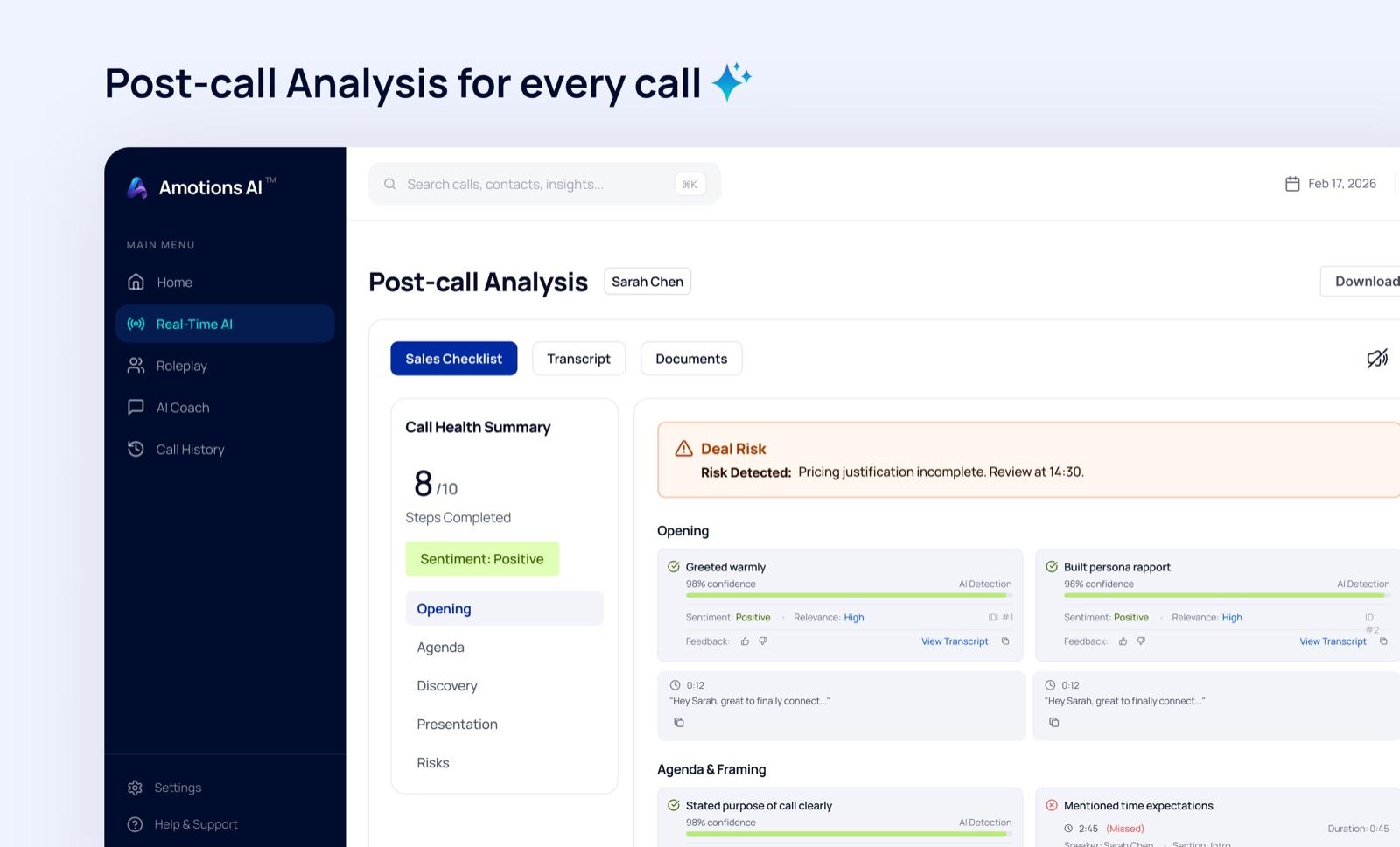
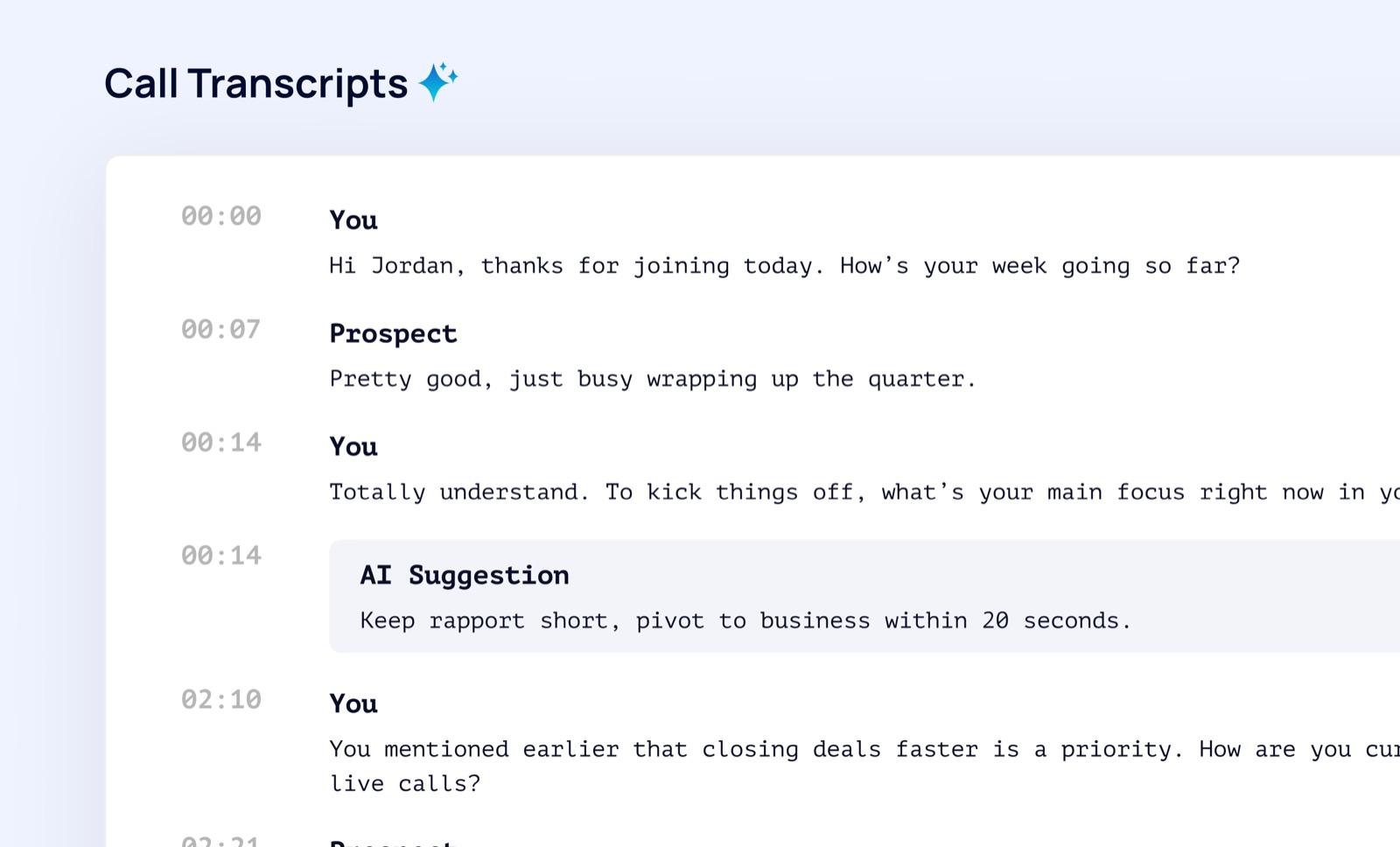
An AI communication scorecard is a rubric that evaluates how someone communicates in a conversation against defined criteria—such as listening, warmth, confidence, pacing, empathy, emotional responsiveness, and organization-specific standards—then produces scores, evidence, and coaching for the next conversation.
Communication quality is often judged by whoever happened to hear the conversation. That makes coaching uneven: two managers can watch the same consult and walk away with different notes, and two locations can train the same playbook into different habits. Factual knowledge is easier to test than whether someone sounded rushed, skipped listening, or never made the next step clear.
“Good communicator” usually means a feeling, not a shared rubric. Without criteria, feedback depends on who is coaching.
Ride-alongs and spot-checks sample a few conversations. The rest of the team is coached from memory, CRM notes, or nothing.
Multi-site teams often discover that “our standard” is actually several standards—one per manager, provider, or office.
Quizzes can check whether someone knows the product. They cannot tell you whether the conversation felt warm, paced, or patient-centered.
The working loop is: define the standard → analyze the conversation → evaluate against criteria → produce scores and evidence → give feedback → find patterns → coach the next conversation.
1
Turn playbooks, values, workflows, and conversation objectives into named criteria—what good looks like for this organization.
2
Score live, practiced, or uploaded conversations on a supported capture path. The scorecard applies to the conversation you can actually review.
3
Each criterion is assessed with evidence from the conversation—not a single gut-feel grade for the whole call.
4
The output is a score plus notes tied to behaviors (listening, warmth, next-step clarity), so people can see why the number landed there.
5
Coaching points to a specific behavior to repeat or change before the next conversation.
6
The same rubric makes it possible to see whether a gap is one person, one office, or a team-wide habit.
7
Use the same criteria in roleplay, live guidance, and review so the next conversation is measured the same way.
This is the scoring layer inside AI communication intelligence. Sales-call mechanics also have a dedicated AI call scoring path.
Use this as a starting structure—not as a customer result. Replace rows, weights, and passing bars with your playbook.
Example AI communication scorecard
Illustrative example
| Criterion | What good looks like | Example evidence | Score |
|---|---|---|---|
| Listening | The other person is heard before they are answered. | Paraphrase before responding | 1–5 |
| Warmth | The conversation feels human, not purely transactional. | Greeting and acknowledgment before process | 1–5 |
| Confidence | Recommendations and next steps are clear. | States a plan without hedging it away | 1–5 |
| Pacing | There is room to think and respond. | Does not rush past questions or silence | 1–5 |
| Clarity | Explanations are understandable. | Plain language; checks understanding | 1–5 |
| Empathy | Emotion and stakes are acknowledged. | Names the worry before explaining options | 1–5 |
| Emotional responsiveness | The speaker adjusts when the other person is hesitant or frustrated. | Slows down after a concern instead of pushing the pitch | 1–5 |
| Discovery | Needs and priorities are understood before recommending. | Open questions before a recommendation | 1–5 |
| Objection handling | Concerns are addressed without steamrolling. | Clarifies the objection, then responds | 1–5 |
| Next-step clarity | Someone leaves knowing what happens next. | Confirms owner, timing, and action | 1–5 |
Draft a version of this rubric in the custom scorecard builder, or paste a playbook into the sales coaching scorecard builder.
Yes. Different organizations should define different criteria. A dental consult, an insurance coverage talk, a listing appointment, a leasing tour, and a B2B discovery call do not share one universal “great communicator” template.
Consult warmth, listening, treatment explanation, and next-step agreement against the practice’s own communication standard.
Coverage conversations for insurance agents, scored on clarity, confidence, and how price or trust concerns are handled.
Listing, buyer, and owner conversations scored on discovery, pacing, and next-step clarity.
Phone inquiries and tours for leasing professionals, scored on listening, warmth, and whether the application next step was clear.
Listing, owner, and tenant conversations for CRE brokers, scored on discovery, pacing, and next-step clarity.
Sales professionals score discovery, objections, and closes as communication quality as well as sales process.
Dental practices are a clear case for communication scorecards: treatment conversations are high-stakes, providers work independently, and “how it felt” is hard to coach from memory. Amotions’ dental communication coaching pages describe scoring real doctor-patient conversations against a practice’s own standards—preferring post-conversation analysis so doctors stay focused on the patient.
A shared scorecard gives multi-provider and multi-location teams one definition of the consult standard, instead of a different coaching bar in every chair.
Criteria such as rapport, discovery, treatment recommendation, empathy, and next-step agreement can be written down, scored, and reviewed with evidence.
Warmth, pacing, and confidence can be part of the rubric so coaching is not limited to whether a clinical fact was stated.
Scorecards can require that the conversation stay centered on the patient’s concerns before a recommendation—not only on presenting findings.
The same rubric on later consults shows whether coaching changed the next conversation. This page does not invent dental outcome statistics.
AI dental communication coaching · Custom scorecard builder. Named dental-practice outcome statistics are not published on this page.
AI scoring is useful because it can apply the same criteria, at the same bar, across more conversations than a manager can sit in on. Human judgment stays in the loop for calibration, exceptions, and decisions the organization should not fully automate.
House of Hearing — Owner Jake LeRoy
House of Hearing used Amotions AI roleplay before consults and scorecard coaching after live conversations. Results below are customer-reported by owner Jake LeRoy and documented on the published customer story.
Baseline
Providers practiced mainly on live patients; consult quality depended on scarce ride-alongs and informal review. The team had contacted about five other vendors before choosing Amotions for responsive live support.
Rollout period
Started with Jake LeRoy and a couple of providers, then built a weekly team meeting around AI scorecards and roleplay before expanding the coaching cadence across the cohort.
Measured outcome
Jake LeRoy reported that monthly sales rose by $160,000 in a single month after adopting Amotions AI—the highest month his team had ever had. A provider who had never sold a top-of-the-line device closed one after repeated roleplay practice.
Source: House of Hearing customer story
House of Hearing is a hearing-care consult story, not a dental outcome. Authorship and methodology: Trust and Evidence. More stories: customer stories. In-person capture paths: in-person coaching.
An AI communication scorecard is a rubric that scores how someone communicates in a real conversation against defined criteria—such as listening, warmth, confidence, pacing, empathy, and organization-specific standards—then turns those scores into coaching. It is not a transcript-only review and not a personality test.
You score communication by defining criteria, analyzing a conversation against those criteria, and producing a score with evidence for each row. Amotions helps organizations do that with customized scorecards rather than a single generic grade.
Yes. AI can score communication quality against criteria an organization defines—how the conversation was delivered, not only which words were used. That is a coaching measurement against your standard, not a claim of a universal scientific grade for every industry.
Yes. Tone can be scored as a communication criterion when the organization defines what good tone looks like in its conversations. Amotions treats tone as one dimension of how the conversation was experienced, alongside wording.
Yes. Organizations can customize scoring from playbooks, values, workflows, customer-experience standards, top-performer behavior, and conversation objectives. A dental consult, a leasing tour, and a sales discovery call should not share one forced template.
Behaviors that can be scored include listening, warmth, confidence, pacing, clarity, empathy, emotional responsiveness, discovery, objection handling, and next-step clarity—plus any organization-specific row you add to the scorecard.
Yes. Healthcare and dental teams can configure communication scorecards for consult quality—typically as post-conversation analysis so providers stay focused on the patient. Data is hosted on Google Cloud, encrypted in transit and at rest, and isolated per workspace. Each practice sets its own patient notice policy for recorded conversations. We sign a Business Associate Agreement (BAA) with your practice, and our hosting provider, Google Cloud, is covered by a signed BAA with Amotions. Ask us for the BAA before you share patient information. Details: https://amotionsinc.com/security#healthcare.
Yes. Sales professionals and sales teams use communication scorecards alongside sales-process criteria so discovery, objections, and closes are coached as communication quality, not only as checklist completion.
Yes. In-person conversations can be scored when audio is captured on a supported path—such as the Desktop App when appropriate, or an approved recording or notes upload after the meeting. That is not a claim of unsupervised always-on field recording.
Communication scoring evaluates how people communicate against defined quality criteria such as listening, warmth, confidence, pacing, and empathy. Call scoring in Amotions is a related sales-call capability focused on execution such as discovery, objections, and next steps. Many teams use both: a communication scorecard for quality, and AI call scoring for sales-call mechanics.
Category pillar: how Amotions analyzes tone, pacing, warmth, listening, and empathy—then coaches against your standards.
How Amotions analyzes tone, pacing, warmth, and listening—then scores conversations against your standards.
Score live conversations against playbook and communication criteria.
Practice before the conversation, coach during it, and score afterward.
Product overview: live coaching, roleplay, and post-call feedback in one platform.
Consult and care conversations scored on warmth, listening, and next steps.
Producer conversations coached on discovery, premium framing, and objections.
Authorship, methodology, and how published claims are labeled.
Published proof from teams using roleplay, live coaching, and scorecards.
See how Amotions AI combines live guidance, AI roleplay, and post-call feedback in one platform.
Live dental coaching for treatment plans, case acceptance, roleplay, and scorecards.
Book a walkthrough of customized communication scorecards, or draft criteria in the public builder first.
Start free on Basic, or watch live coaching on a simulated call first. No bot joins your calls.
“Amotions AI is extremely useful for installing those fundamentals…”