Sales
Real-Time AI Sales Coach
Private prompts while the conversation is still open—then the same communication criteria in roleplay and post-call scores.
Open the real-time sales coachCommunication Intelligence
AI communication intelligence analyzes how people communicate—not just the words they say. Amotions AI helps customer-facing professionals understand, measure, and improve how they communicate by scoring tone, pacing, warmth, listening, empathy, confidence, and conversation dynamics against an organization’s own standards.
Published By Pianpian Xu Guthrie, Founder and CEO
Core positioning
Your definition of great communication.
Amotions AI helps customer-facing professionals understand, measure, and improve how they communicate. Amotions analyzes not just what people say, but how they communicate. It does not replace an organization’s judgment about what great communication is. It turns that definition—playbooks, values, workflows, and best-practice behaviors—into criteria teams can practice, see in the moment, and improve after the conversation.
AI communication intelligence is software that analyzes how people communicate in conversations—including tone, emotional cues, pacing, warmth, confidence, listening, empathy, conversation dynamics, and behavioral patterns—then turns those observations into scoring, feedback, and coaching against defined communication standards.
Customer-facing teams whose outcomes depend on how a conversation feels—not only whether the script was said. Typical fits are sales, healthcare consults, dental treatment conversations, leasing tours, and other roles where listening, pacing, and next-step clarity change the result.
If the job is “make sure the words were said,” a transcript may be enough. If the job is “make the next conversation better against our standard,” you need scoring and coaching on how it was communicated.
Interactive example
Pick an authored example conversation. Amotions is not listening to you and is not scoring a file you uploaded. The scores below show how the same product concept works: criteria, evidence, and a coaching note.
Illustrative example — not a live analysis of your conversation, and not a customer result. Amotions scores real conversations against your organization’s criteria after a supported capture path.
Sales: Price objection on a live call
Example outbound call. The prospect says the fee is higher than a competitor. This snippet is authored for the page, not taken from a recorded customer.
Prospect: “You’re more expensive than the other quote.” Seller: “Yeah, a lot of people say that. We can probably do something on price. What number did they give you?”
Organizations measure communication quality as behaviors they defined—not a vendor’s generic personality score. Typical measurements:
Listening, warmth, empathy, confidence, pacing, and playbook-fit as named rows with evidence.
Roleplay, live prompts, and post-conversation scores use one definition of great communication.
What to repeat, what to change, and which behavior to practice next—not a dashboard of talk time alone.
Whether a gap is one person, one office, or a team habit—once the rubric is shared.
A transcript answers what was said. Communication intelligence also asks how it was communicated. The same sentence can land as rushed, warm, uncertain, confident, or dismissive depending on delivery, listening, and the dynamics of the exchange. That difference is visible to the other person even when the words look complete.
Rushed delivery
What was said. The right facts can still be in the transcript.
How it was communicated. If the delivery is rushed, the other person may feel hurried or unheard even when the content is accurate.
Lack of warmth
What was said. A greeting and a process explanation can look complete on paper.
How it was communicated. Without warmth, the same script can feel transactional instead of like a conversation with a person.
Uncertainty
What was said. A recommendation may be present in the words.
How it was communicated. Hedging, trailing off, or unclear next steps can make the same recommendation feel uncertain.
Confidence
What was said. Two people can use similar language.
How it was communicated. Steady pacing and a clear recommendation can communicate confidence that a transcript alone does not capture.
Emotional responsiveness
What was said. A concern may be answered with a fact.
How it was communicated. Whether the speaker first acknowledges the emotion changes how that fact lands.
Listening
What was said. Questions may appear in the transcript.
How it was communicated. Interrupting, talking over answers, or skipping a paraphrase can show that listening did not actually happen.
Pacing
What was said. The agenda items may all be covered.
How it was communicated. Speaking too fast, or leaving no space to think, changes the experience of the same agenda.
Conversational dynamics
What was said. Both sides may have spoken.
How it was communicated. Turn-taking, dominance, and whether the conversation stayed two-sided shape the outcome beyond the word list.
These are practical conversation observations, not laboratory claims about psychology. The point is operational: if you only score keywords, you miss the behaviors that shape trust, clarity, and whether someone feels heard.
Amotions analyzes communication dimensions that describe how a conversation is experienced, then scores them against the criteria an organization sets. The list below is the working set this platform is designed around—not a claim that every vendor lacks these signals.
| Dimension | What it looks at | Example in a conversation |
|---|---|---|
| Tone | How the speaker sounds—not only which words were chosen. | Calm vs. clipped; professional vs. dismissive. |
| Emotional cues | Signals that emotion is present and whether it is recognized. | A worried pause, a frustrated interruption, a relieved “okay.” |
| Pacing | Speed, pauses, and whether there is room to think. | Rushing a recommendation before the other person finishes. |
| Warmth | Whether the conversation feels human and approachable. | A genuine greeting versus jumping straight into process. |
| Confidence | Clarity and conviction in recommendations and next steps. | A clear plan versus hedging every sentence. |
| Listening | Whether the other person is actually heard. | Paraphrasing a concern before answering it. |
| Empathy | Whether feelings and stakes are acknowledged in the moment. | Naming a worry before explaining a product or plan. |
| Conversation dynamics | How the exchange moves between people. | Turn-taking, interruptions, and whether one side dominates. |
| Behavioral patterns | Repeated communication habits across conversations. | Skipping discovery, over-talking, or closing without a next step. |
Those observations become useful when they are tied to the Amotions AI product loop: practice, live guidance, and scored feedback. Choosing between conversation intelligence and live coaching? Read real-time coaching vs post-call analytics.
Great communication is not a universal template. A dental consult, a mortgage disclosure, and a leasing tour should not be scored as if they were the same conversation. Amotions is built so organizations can define the standard—then measure and coach against it.
Talk tracks, discovery frameworks, and approved responses become observable behaviors—not just documents people are told to follow.
If the organization values respect, transparency, or patient-centered care, those values can be written as communication criteria.
Intake, qualification, handoff, and follow-up steps can be scored as conversation behaviors, not only CRM checkboxes.
Service promises—how people should feel after a consult, tour, or claim discussion—become measurable communication expectations.
What strong communicators actually do in live conversations can be turned into criteria others can practice and be coached on.
Each conversation type can have a job: understand needs, earn trust, explain options, or agree a next step—and scoring can reflect that job.
Teams typically start by uploading playbooks and process docs, then refine criteria as they review real conversations. See how to train Amotions on your process and the custom scorecard builder—that tool generates a real draft scorecard from your inputs, unlike the illustrative example above.
A communication scorecard turns those standards into measurable criteria. Each row is a behavior someone can practice, notice during a live conversation, and review afterward. Weights and passing bars belong to the organization—not to a generic industry average.
Example communication scorecard
Illustrative example
| Criterion | What good looks like | Example signal | Score |
|---|---|---|---|
| Warmth | The other person feels welcomed, not processed. | Greeting and acknowledgment before jumping to process | 1–5 |
| Listening | Concerns are heard before they are answered. | Pause, paraphrase, then respond | 1–5 |
| Empathy | Emotion is acknowledged, not skipped. | Names the worry before explaining options | 1–5 |
| Confidence | Recommendations are clear and usable. | States a next step without hedging it away | 1–5 |
| Pacing | The conversation has room to think. | Does not rush past questions or silence | 1–5 |
| Playbook fit | Required workflow behaviors happened. | Discovery question asked before a recommendation | 1–5 |
After conversations, scorecards sit beside coaching notes so managers are not limited to listening to every recording. Product screens of that workflow are below; the features page covers scoring in more detail.
These are real Amotions AI product screens: private live guidance, AI roleplay, and post-conversation scorecards. They show the same loop described on this page—not stock photography.
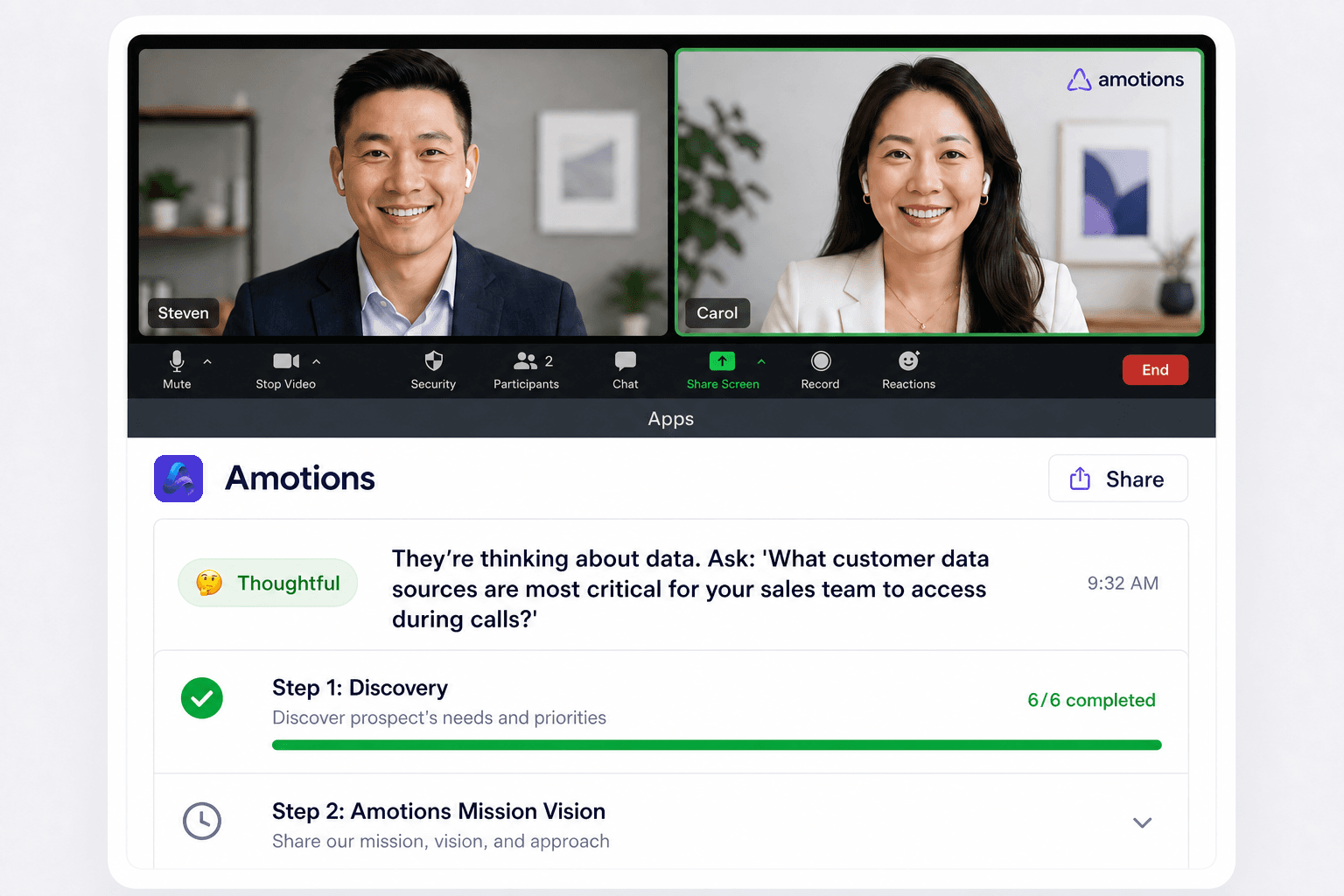
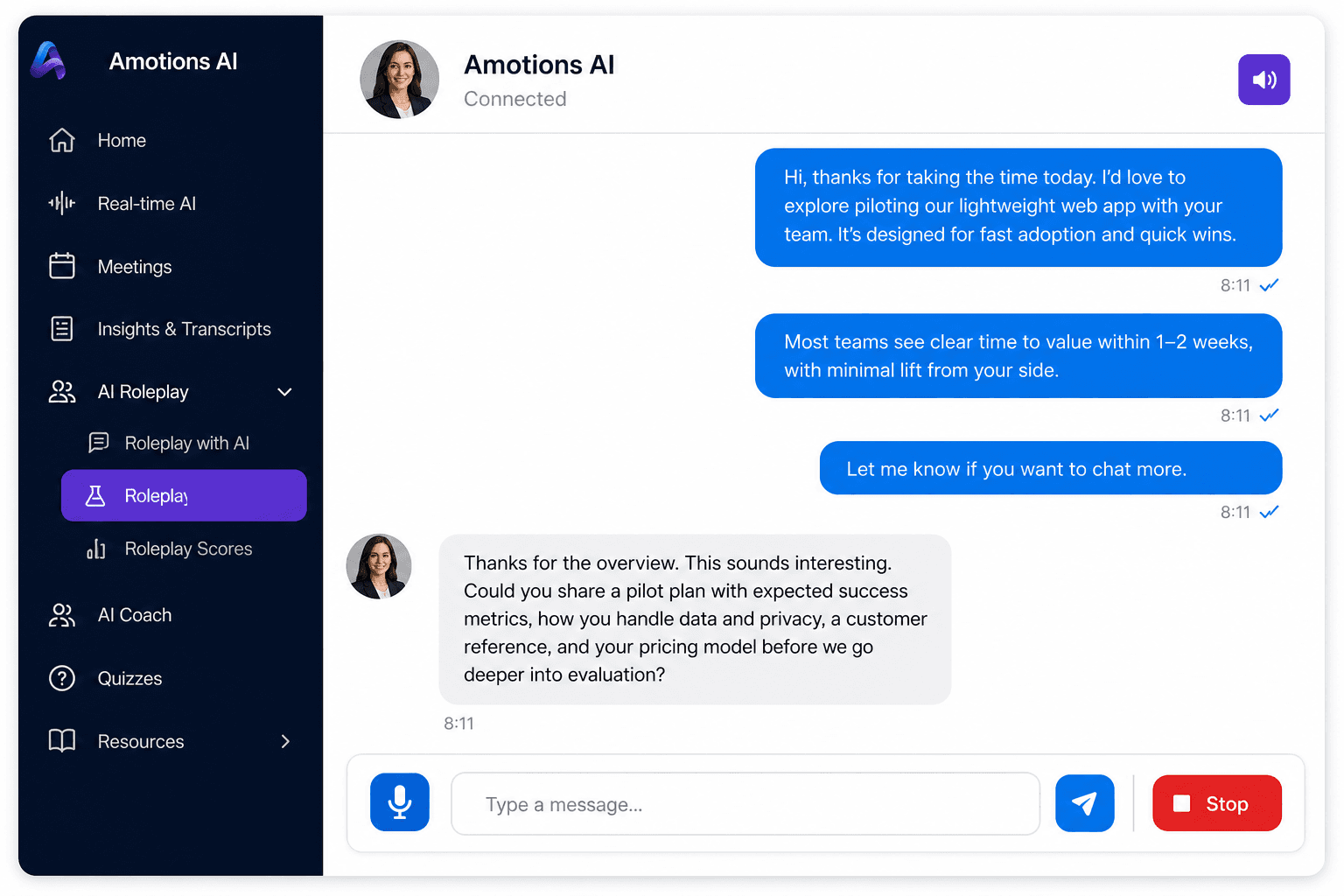
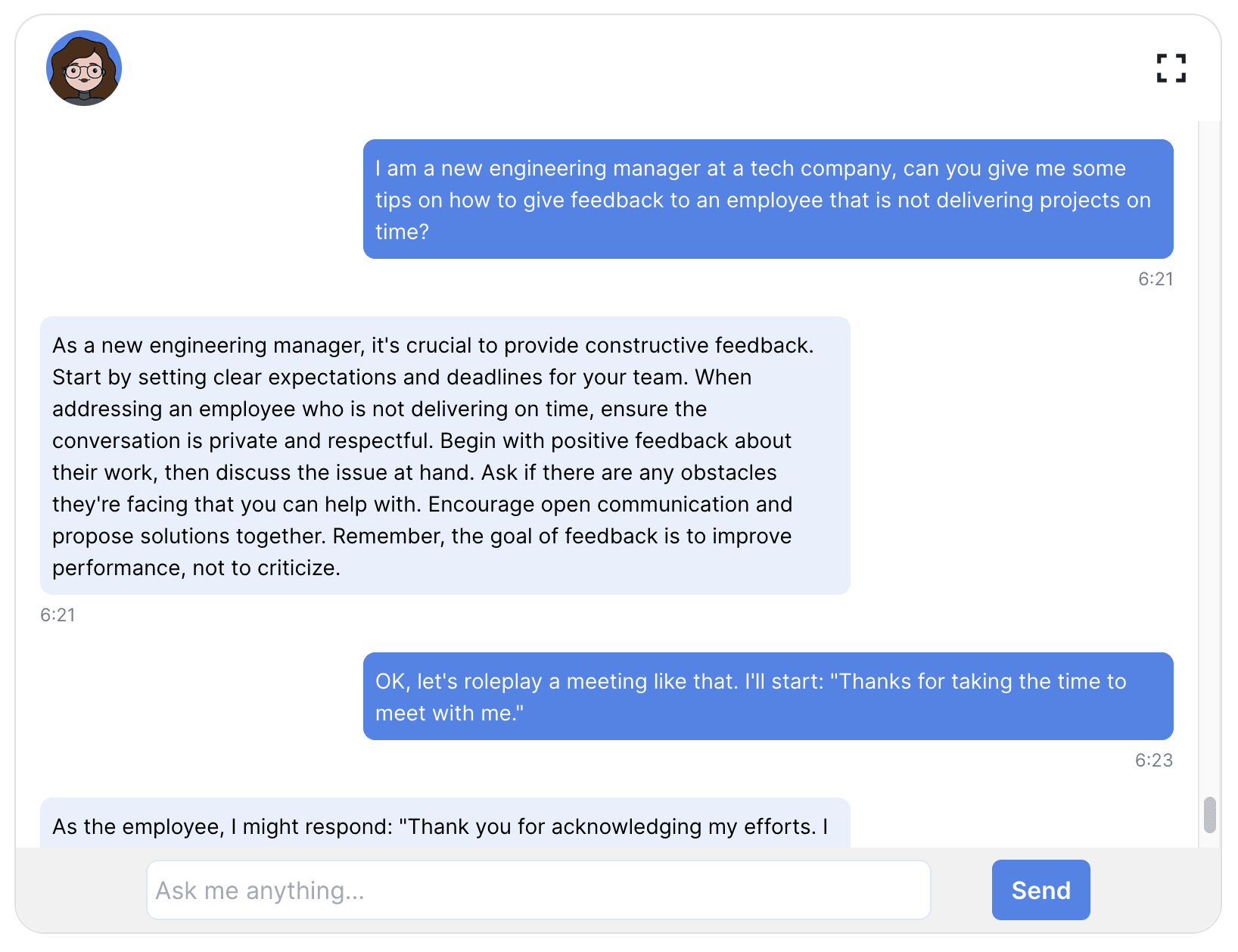
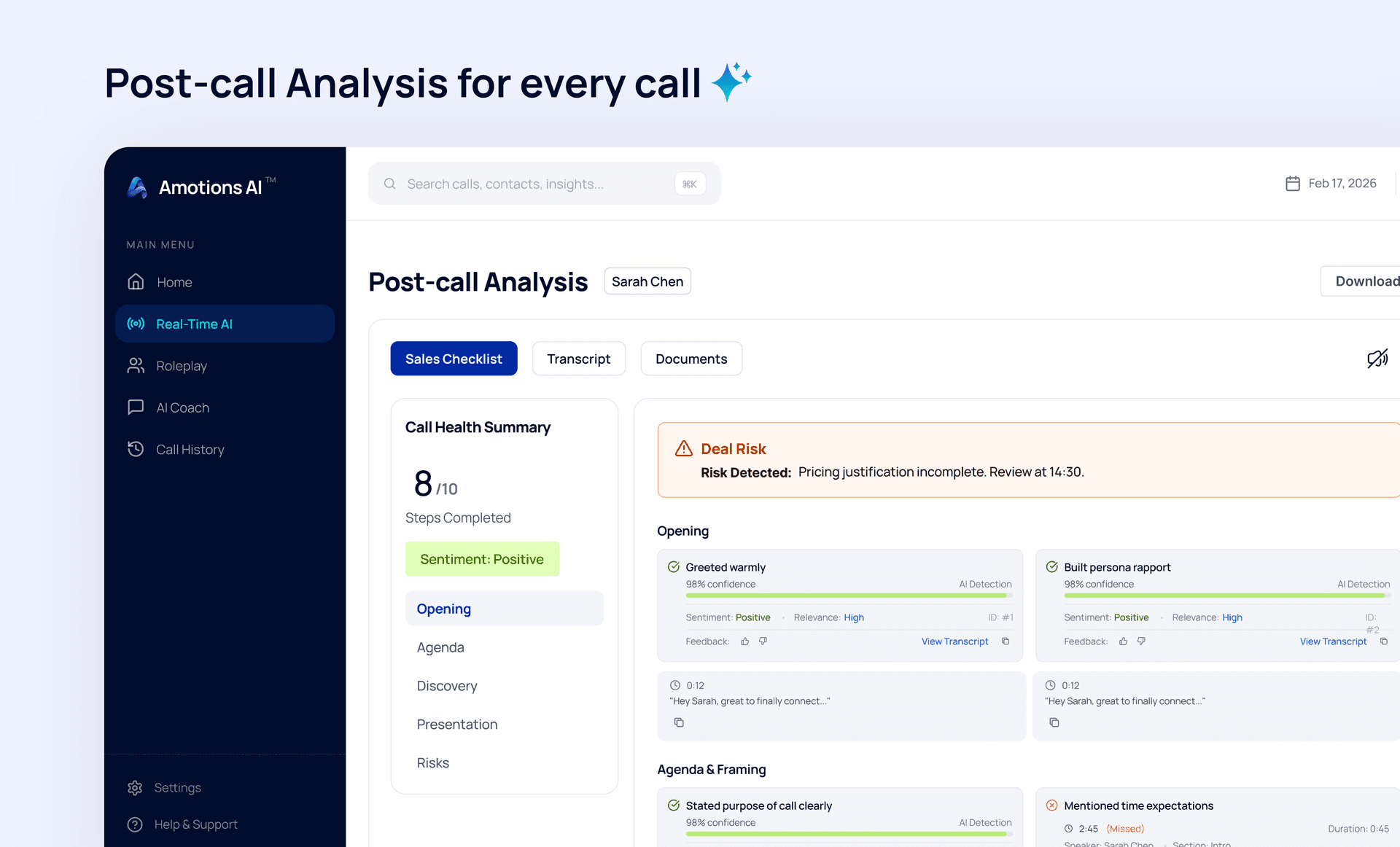
Communication intelligence is most useful when it is a loop, not a report. Amotions supports the same criteria across practice, live conversations, and review.
Before
Rehearse high-stakes conversations against your criteria before they happen with a real customer, patient, or prospect.
AI roleplayDuring
Private prompts during live conversations help people adjust tone, questions, listening, and next steps while the other person is still there.
Real-time AI sales coachAfter
Each conversation can produce a communication scorecard and coaching notes against your standards—so the next conversation improves.
AI call scoringThis is a comparison of emphasis, not a claim that conversation intelligence platforms cannot analyze tone, emotion, or behavior. Many can. Amotions is built to turn communication quality into coaching against your organization’s standards—before, during, and after the conversation.
| Dimension | Traditional conversation intelligence (typical emphasis) | Amotions communication intelligence (emphasis) |
|---|---|---|
| Primary job | Record, analyze, and review conversations after they happen | Improve how people communicate against defined standards |
| Timing | Often after-call insight and manager review | Practice before, private guidance during, and scoring after |
| Standards | Platform analytics and review workflows | Organization-specific playbooks, values, and communication criteria |
| What is measured | Words, topics, and conversation analytics—often including behavior | Communication quality, including tone, pacing, warmth, listening, empathy, and conversation dynamics |
| Output | Insights, recordings, and trends for review | Actionable coaching, scorecards, and a continuous improvement loop |
| Live guidance | Typically a review workflow after the conversation | Real-time private prompts while the conversation is still happening |
Each path below is an existing Amotions page—not a duplicate Communication Intelligence essay. Pick the conversation you actually run.
Sales
Private prompts while the conversation is still open—then the same communication criteria in roleplay and post-call scores.
Open the real-time sales coachHealthcare
Score consults on listening, warmth, and how options are explained—against the clinic’s own communication standard.
Open doctor-patient coachingDental
Treatment conversations and case acceptance coached as communication quality, not only whether an estimate printed.
Open dental communication coachingLeasing
Phone inquiries, tours, and application conversations measured against leasing communication standards.
Open the AI leasing coachOther customer-facing teams
Insurance, mortgage, customer success, and other high-stakes conversations use the same loop: define the standard, then practice, live-coach, and score.
Contact / demoAlso used in insurance, mortgage, real estate, and customer success. See AI sales coach, insurance sales coaching, and in-person conversation coaching.
The working loop is: conversation → analysis → organization-specific criteria → score → feedback → coaching → improved future conversations.
1
A live, practiced, or uploaded conversation is captured on a supported path.
2
Amotions analyzes what was said and how it was communicated—tone, pacing, warmth, listening, and related dimensions.
3
Observations are mapped to your playbooks, values, workflows, and definition of great communication.
4
The conversation receives a communication score against those criteria—not a generic one-size score alone.
5
People get specific coaching notes on what to repeat and what to change.
6
Managers and individuals use roleplay and live guidance to practice the same behaviors.
7
The next conversation starts from a clearer standard, so improvement compounds.
Phone and Zoom paths are overlays, not meeting bots. See phone coaching and Zoom coaching, or the full integrations hub.
House of Hearing — Owner Jake LeRoy
House of Hearing used Amotions AI roleplay before consults and scorecard coaching after live conversations. Results below are customer-reported by owner Jake LeRoy and documented on the published customer story.
Baseline
Providers practiced mainly on live patients; consult quality depended on scarce ride-alongs and informal review. The team had contacted about five other vendors before choosing Amotions for responsive live support.
Rollout period
Started with Jake LeRoy and a couple of providers, then built a weekly team meeting around AI scorecards and roleplay before expanding the coaching cadence across the cohort.
Measured outcome
Jake LeRoy reported that monthly sales rose by $160,000 in a single month after adopting Amotions AI—the highest month his team had ever had. A provider who had never sold a top-of-the-line device closed one after repeated roleplay practice.
Source: House of Hearing customer story
Methodology and authorship live on Trust and Evidence. More customer-reported stories are on customer stories.
AI communication intelligence analyzes how people communicate—tone, emotional cues, pacing, warmth, confidence, listening, empathy, conversation dynamics, and behavioral patterns—not just the words they say. Amotions AI uses that analysis so customer-facing professionals can understand, measure, and improve conversations against an organization’s own standards.
AI analyzes communication by examining both what was said and how it was delivered. Amotions looks at dimensions such as tone, pacing, warmth, confidence, listening, empathy, and conversation dynamics, then maps those observations to criteria the organization defines.
Yes. Amotions AI can analyze tone as a communication dimension and score it against the criteria an organization defines. Tone is one part of how a conversation is experienced, alongside wording.
Yes. Empathy can be scored as a communication criterion when an organization defines what empathetic communication looks like in its conversations—for example, acknowledging emotion before advancing a recommendation. That is a coaching measurement against your standard, not a clinical diagnosis.
Yes. Amotions AI turns communication standards into scorecards so conversations can be scored, compared, and coached over time. Scores reflect the organization’s criteria, not a single generic grade for every team.
Yes. Organizations can customize scoring from playbooks, values, workflows, customer experience standards, top-performer behavior, and conversation objectives. That is the core of “your definition of great communication.”
Yes. Amotions can analyze in-person conversations when audio is captured on a supported path—such as the Desktop App when appropriate, or an approved recording or notes upload after the meeting. It is not a claim of unsupervised always-on field recording.
Yes. Amotions works during computer-based phone calls when call audio is available on the computer via the Desktop App or a supported overlay. Real-time coaching on a mobile phone device is not a published live path.
No. Amotions does not join Zoom meetings as a participant or meeting bot. Zoom desktop meetings can use the Amotions AI desktop app or a private overlay so guidance stays on the professional’s screen.
Amotions emphasizes actionable coaching, organization-specific standards, communication quality, behavioral and emotional dimensions, real-time guidance, and continuous improvement. Traditional conversation intelligence often emphasizes after-call analysis, recordings, and review. Many conversation intelligence platforms can also analyze communication behavior; the difference is emphasis and coaching loop, not a claim that those tools cannot analyze tone or emotion.
Amotions is for customer-facing professionals and teams whose conversations affect outcomes—sales professionals, providers, dentists, insurance agents, loan officers, CRE brokers, leasing professionals, and other high-stakes customer conversations. It is emotionally intelligent AI for customer-facing teams, not a recording dashboard alone.
No. The interactive example uses authored sample dialogue and pre-written scores so you can see how criteria, evidence, and coaching notes work. Amotions scores real conversations only after a supported capture path—not from this page’s example picker.
Score live conversations against playbook and communication criteria.
Score live and recorded conversations on warmth, listening, pacing, and playbook criteria.
Practice before the conversation, coach during it, and score afterward.
Product overview: live coaching, roleplay, and post-call feedback in one platform.
Private guidance while the seller is still in the live conversation.
Consult and care conversations scored on warmth, listening, and next steps.
Producer conversations coached on discovery, premium framing, and objections.
Treatment conversations coached against practice-defined communication criteria.
Authorship, methodology, and how published claims are labeled.
Published proof from teams using roleplay, live coaching, and scorecards.
Start free to practice and coach live, or book a demo if you want the loop on your playbook. The example on this page is illustrative; real scoring happens on conversations you capture in Amotions.
Start free on Basic, or watch live coaching on a simulated call first. No bot joins your calls.
“Amotions AI is extremely useful for installing those fundamentals…”