CUSTOM AI SALES COACH

Your Sales Process. Your Playbook. AI Coaching on Every Call.

Amotions AI is a custom AI sales coach trained on your process: load playbooks, scripts, product knowledge, and objection handling, then get private live coaching, AI roleplay, and post-call feedback that reinforces how your team actually sells.

Amotions AI gives every rep private real-time coaching based on the company’s own sales process, playbooks, product knowledge, objection handling, and best practices—so guidance sounds like your methodology, not generic advice.

Published Updated By Pianpian Xu Guthrie, Founder and CEO

Build Your AI Sales CoachBook a Demo

What is real-time AI sales coaching?

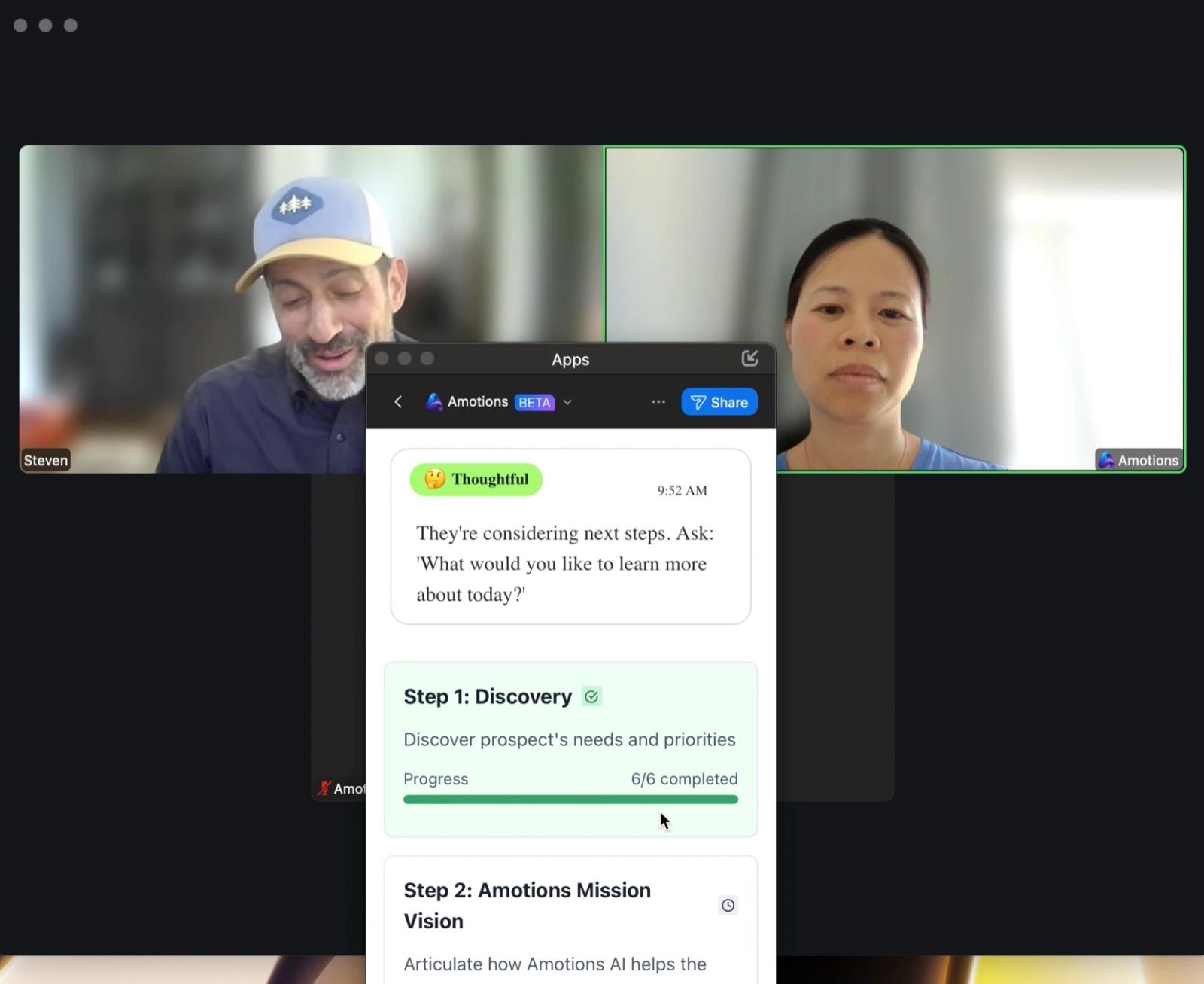
Real-time AI sales coaching—also called real-time AI assistance during sales calls—analyzes a live conversation and surfaces private prompts to the seller during the call: better discovery questions, AI objection handling and rebuttal suggestions, listening cues, and next-best actions—so the rep can adjust before the opportunity is lost.

How Amotions becomes your company-trained AI sales coach

The goal is simple: turn your sales methodology into a live AI coach that helps reps execute it during real customer conversations.

1

Upload your sales process

Map the stages your team actually runs—discovery, qualification, demo, proposal, negotiation, close—so coaching follows your sequence.

2

Add playbooks, scripts, product knowledge, and objection handling

Load the materials enablement already owns: talk tracks, approved responses, pricing guardrails, competitor notes, and tribal knowledge.

3

Configure coaching rules

Define what “good” looks like on a call: required questions, disclosures, stage exits, and when to advance vs dig deeper.

4

Practice with AI roleplay

Reps rehearse your scenarios before live risk—same playbooks that will coach them on real calls.

5

Get private AI guidance during live calls

During the conversation, Amotions surfaces concise private prompts the customer does not see.

6

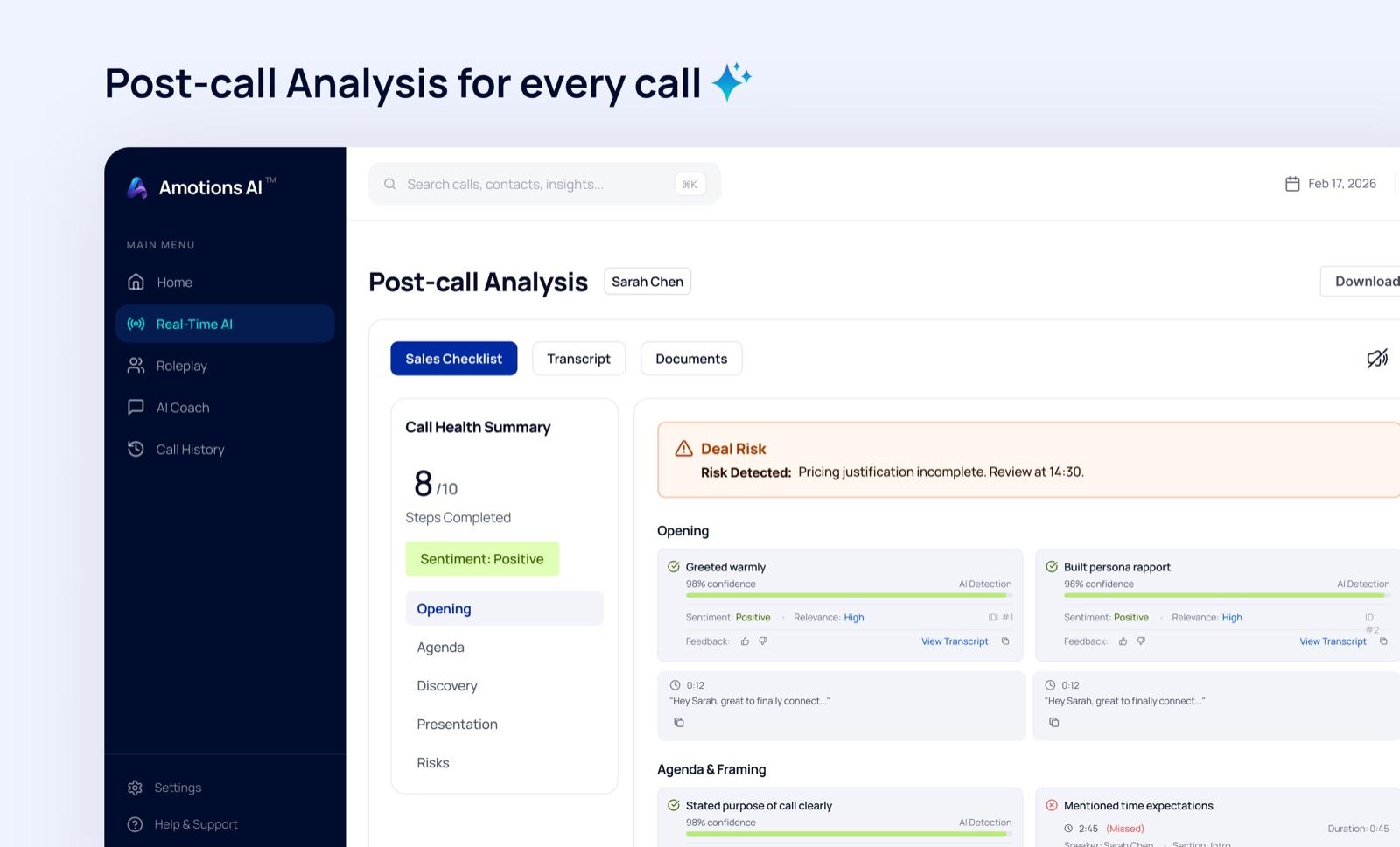
Review post-call feedback

Afterward, feedback ties to your process: discovery quality, objection recovery, next-step clarity, and talk-track adherence.

7

Improve the playbook based on real conversations

Use patterns from coached calls to refine scripts, objection paths, and coaching rules—so the AI gets sharper with your team.

Generic AI gives generic advice. Your reps need your process.

Off-the-shelf models can sound helpful and still miss how your company sells. A custom AI sales coach trained on your playbook closes that gap.

Generic AI

Ask an open-ended question.

Company-trained AI

Based on our discovery framework, ask about X before discussing pricing.

Process vs platitudes

Generic tips stay abstract. Company-trained coaching references your stage exits, qualifying criteria, and approved next steps.

Your language

Prompts can use your terminology, product names, and brand voice—so reps do not sound like a default chatbot.

Guardrails that matter

Pricing ranges, compliance reminders, and objection trees stay inside what enablement already approved.

Example: company context turns a stall into a next step

Illustrative example of how an AI sales coach trained on company knowledge can respond in the moment. Not a live model output or a customer recording.

Prospect statement

“We’re interested, but we need to think about it.”

Company context

Your playbook treats “think about it” as unfinished discovery or a missing stakeholder—not a polite no. Pricing is discussed only after impact and decision process are clear.

Recommended response

Acknowledge the pause, then ask which open item they need to resolve—fit, timing, budget owner, or a second stakeholder—before offering another meeting or a proposal.

Next-best action

Book a short follow-up with a named agenda (and the missing stakeholder if needed) instead of ending on an open-ended “I’ll follow up later.”

See the difference: generic AI vs trained Amotions AI

Pick a stage in your sales process and a knowledge source. The prospect line stays the same—the coaching quality does not. Illustrative demo only; not a live model response.

Hardcoded illustrative responses keyed to stage + knowledge. Not a customer call or live LLM output.

Step 1: Your sales process

Discovery → Qualification → Demo → Trial Close → Objection → Close

Step 2: Your company knowledge

Step 3: Simulated prospect

Prospect

I'm interested, but I need to think about it.

Generic AI

Ask the prospect what they need to think about.

Amotions AI (trained)

Use your approved “think about it” response: acknowledge, isolate (fit / timing / authority / risk), then answer only the named concern.

Full trained response library

Prospect: “I'm interested, but I need to think about it.”. Generic AI: “Ask the prospect what they need to think about.”.

  • Stage Discovery, knowledge Playbook: “Stay in discovery: acknowledge the pause, then ask which discovery gap still feels unresolved—using your playbook’s “interest without clarity” branch before you advance.
  • Stage Discovery, knowledge Product knowledge: “Do not pitch features yet. Ask which product outcome they still need to understand before they can decide—tie the follow-up to the capability they already hinted at.
  • Stage Discovery, knowledge Objections: “Treat “I need to think” as an early soft objection. Clarify whether they are unsure about fit, timing, or stakeholders—per your discovery objection tree.
  • Stage Discovery, knowledge Scripts: “Use your approved discovery script: “Happy to pause—what specifically do you want to think through so we cover it while we’re together?”
  • Stage Discovery, knowledge Pricing: “If pricing has not been introduced, do not lead with cost. Ask whether the rethink is about value vs alternatives, or whether budget owners are still unknown.
  • Stage Discovery, knowledge Brand voice: “Respond in your consultative voice: calm, specific, and buyer-led. Invite them to name the open question without pressure or a hard close.
  • Stage Qualification, knowledge Playbook: “Map the stall to qualification: ask which BANT/MEDDIC-style criterion is incomplete—budget, authority, need, or timeline—using your team’s stage exit criteria.
  • Stage Qualification, knowledge Product knowledge: “Confirm whether the product use case is qualified. Ask which success criteria still feel fuzzy before they take time offline.
  • Stage Qualification, knowledge Objections: “Probe the real concern behind the stall: is it priority, risk, or missing stakeholders? Match your qualification objection labels, not a generic “think about it.”
  • Stage Qualification, knowledge Scripts: “Run the qualification hold script: “Totally fair—on a scale of fit vs timing, which part needs more thought so we qualify the next step correctly?”
  • Stage Qualification, knowledge Pricing: “Check whether price was a silent qualifier. Ask if they have a range or approval path, without volunteering a discount.
  • Stage Qualification, knowledge Brand voice: “Keep the brand tone: precise and respectful. Frame the question as helping them qualify—not trapping them into a yes.
  • Stage Demo, knowledge Playbook: “Per your demo playbook, close the loop on what they saw: ask which capability still needs proof before they can decide, then offer a targeted recap—not a full re-demo.
  • Stage Demo, knowledge Product knowledge: “Anchor on the product moment that mattered. Ask which workflow they want to re-check so “thinking about it” becomes a concrete product question.
  • Stage Demo, knowledge Objections: “After a demo, “think about it” often hides a missing proof point. Ask if the concern is capability, integration, or change management—using your post-demo objection list.
  • Stage Demo, knowledge Scripts: “Use the post-demo script: “What would you need to see again—or from another stakeholder—before this feels ready to decide?”
  • Stage Demo, knowledge Pricing: “If pricing was shown, ask whether the rethink is package fit, total cost of ownership, or comparison to status quo—stay inside approved pricing language.
  • Stage Demo, knowledge Brand voice: “Stay confident and helpful: invite a specific follow-up on the demo takeaway rather than a vague “let me know.”
  • Stage Trial Close, knowledge Playbook: “Your trial-close playbook says to test commitment, not retreat. Ask what would need to be true to move forward this week, then propose a dated next step.
  • Stage Trial Close, knowledge Product knowledge: “Confirm the product value is clear enough to trial-close. Ask which outcome they would measure in the first 30 days if they said yes.
  • Stage Trial Close, knowledge Objections: “Isolate the blocker: “Is this a no for now, or a yes with one open item?” Match the answer to your trial-close objection paths.
  • Stage Trial Close, knowledge Scripts: “Use the trial-close line: “If we solved X, would you be ready to start—or is there another decision still open?”
  • Stage Trial Close, knowledge Pricing: “Offer an approved commercial path only if price is the named blocker—package options or payment timing, never an ad-hoc discount.
  • Stage Trial Close, knowledge Brand voice: “Keep urgency without hype. Sound like a trusted advisor testing readiness, not a closer forcing a signature.
  • Stage Objection, knowledge Playbook: “Enter your objection-handling stage: label “I need to think about it,” then ask for the primary concern category your playbook defines before answering.
  • Stage Objection, knowledge Product knowledge: “If the objection is product-related, ask which capability or risk they want to stress-test—then point to the proof your product knowledge supports.
  • Stage Objection, knowledge Objections: “Use your approved “think about it” response: acknowledge, isolate (fit / timing / authority / risk), then answer only the named concern.
  • Stage Objection, knowledge Scripts: “Deliver the approved rebuttal script: “When people say that, it’s usually one of three things—which feels closest for you?”
  • Stage Objection, knowledge Pricing: “If price is the hidden objection, clarify budget vs value. Stick to approved pricing ranges and trade-offs; do not invent concessions.
  • Stage Objection, knowledge Brand voice: “Handle pushback in brand voice: empathetic, clear, and non-defensive. Never argue; invite the real concern.
  • Stage Close, knowledge Playbook: “Follow your closing framework: confirm mutual commitment criteria, then ask what remains before they can choose a start date.
  • Stage Close, knowledge Product knowledge: “Re-anchor on the agreed product outcome. Ask if anything about delivery, onboarding, or success criteria still needs clarity before close.
  • Stage Close, knowledge Objections: “At close, “think about it” is often last-mile risk. Ask whether the open item is legal, security, or executive sign-off—then route per your close objection map.
  • Stage Close, knowledge Scripts: “Use the close script: “What would make today the right day to move forward—and who else needs to be comfortable?”
  • Stage Close, knowledge Pricing: “Confirm commercial terms are clear. If price is the only open item, present the approved close package—no freestyle discounting.
  • Stage Close, knowledge Brand voice: “Close in your brand voice: direct, respectful, and clear about next steps. Invite a decision without pressure language.

What a company-trained AI sales coach reinforces

One trained coaching brain powers practice, live calls, and review—so reps experience the same methodology everywhere.

Real-time coaching

Private in-call prompts for the next question, objection response, or process step while the buyer is still talking.

AI roleplay

Practice your scenarios, personas, and objections before live risk—with feedback tied to your playbook.

Objection handling

Surface approved rebuttals and diagnostic questions for price, timing, trust, competition, and “think about it.”

Company knowledge

Ground coaching in your product info, pricing, competitive notes, scripts, and tribal knowledge—not the open internet.

Behavioral / emotional intelligence

Cue empathy, pacing, and listening when the conversation gets tense—so process does not override presence.

Post-call feedback

Score and coach against your definition of a good call: discovery depth, objection recovery, and next-step clarity.

Manager visibility

See where reps diverge from the process you trained the coach to reinforce—without joining every call.

What your organization can provide

Enablement and sales leaders already have the materials. Amotions is designed so that knowledge becomes coaching—not a second wiki reps never open mid-call.

  • Sales playbooks
  • Discovery frameworks
  • Qualification criteria
  • Product info
  • Pricing
  • Objection handling
  • Approved responses
  • Scripts
  • Closing frameworks
  • Brand voice
  • Industry terminology
  • Company tribal knowledge

Give 10, 100, or 1,000 reps the same coaching brain.

Enablement already writes the playbook. The hard part is getting every rep to execute it on every call—especially when managers cannot ride along.

A custom AI sales coach trained on your process gives new hires and veterans the same private guidance: your discovery framework, your objection paths, your closing standards. Scale coaching coverage without diluting the methodology.

Consistent execution

The same coaching rules and knowledge base reach every seat—so “how we sell here” is not trapped in a binder.

Faster ramp

Roleplay and live prompts reinforce the playbook on day one, not after months of uneven shadowing.

Manager leverage

Leaders focus 1:1s on judgment and deals while AI covers day-to-day process reminders on live calls.

For larger rollouts, see enterprise AI sales coaching.

Ready to turn your methodology into a live AI coach?

Build an AI sales coach trained on your process so every rep gets private, playbook-aligned guidance on live calls—not generic advice.

Custom AI sales coach FAQ

What is a custom AI sales coach trained on our process?

It is an AI sales coach configured with your sales methodology—stages, playbooks, product knowledge, scripts, and objection handling—so private live prompts and roleplay reinforce how your team sells, not generic tips.

How is this different from ChatGPT or generic AI sales advice?

Generic AI often says things like “ask an open-ended question.” A company-trained coach can say “based on our discovery framework, ask about X before discussing pricing,” using your approved language and stage rules.

Can Amotions AI be trained on our company playbook and sales scripts?

Yes. Teams load playbooks, scripts, product information, pricing guardrails, objection paths, brand voice, and tribal knowledge so coaching stays company-specific across practice and live calls.

Does the AI sales coach work in real time on live calls?

Yes. After you train the coach, Amotions can provide private real-time coaching during supported live conversations—concise guidance the customer does not see—then post-call feedback tied to your process.

What does “AI sales coaching based on our process” mean in practice?

It means prompts follow your stage sequence and coaching rules: required discovery questions, when to introduce pricing, how to handle “think about it,” and what a clear next step looks like for your team.

Can we configure coaching rules for compliance and talk-track adherence?

Yes. Coaching rules can reinforce disclosures, qualifying steps, approved responses, and talk-track adherence so reps get process reminders in the moment without reading a full script aloud.

How does AI roleplay use our company knowledge?

Roleplay scenarios can use your products, objections, and personas so practice matches live risk. Feedback scores against the same playbook that coaches live calls.

Can one custom AI sales coach support 10, 100, or 1,000 reps?

That is a core enterprise use case: give every seat the same coaching brain trained on your process. Managers still own judgment and deals; AI scales day-to-day coaching coverage.

Does the customer see the AI coaching?

No. Guidance is private to the rep’s screen. The buyer hears the seller—not the coaching panel.

How do post-call feedback and playbook improvement work together?

Post-call feedback highlights where calls matched or missed your process. Leaders use recurring patterns to refine scripts, objection handling, and coaching rules so the AI improves with the team.

Who typically builds and owns the company-trained AI sales coach?

Sales enablement, sales managers, and revenue leaders usually own the playbooks and coaching rules. Amotions helps turn those materials into live coaching rather than replacing enablement ownership.

How do we start building our AI sales coach?

Book a demo or contact Amotions to walk through your process and knowledge sources. The first milestone is loading enough playbook and objection context to coach a pilot team on live calls and roleplay.

Custom AI sales coach

Can you train an AI on your sales process? Definition, materials checklist, and proprietary-process clarity.

AI sales coach for NEPQ

Configure Amotions for NEPQ-style Situation through Commitment—roleplay, live coaching, and scoring.

AI sales coaching for service businesses

Process training, AI roleplay, private live coaching, and targeted practice for service-business inside-sales teams.

Live AI sales coach

Private in-call coaching that helps reps know what to say next on live calls.

AI Sales Coach

Definitive guide to real-time AI sales coaching, roleplay, and post-call feedback.

AI objection handling

Live objection coaching patterns that pair with company-trained playbooks.

Sales call coaching playbooks

Playbook-oriented coaching resources for live sales conversations.

Amotions AI product overview

How live coaching sits with AI roleplay and post-call feedback.

AI sales roleplay

Practice with company-specific products, pricing, and objections before live calls.

Enterprise AI sales coaching

Process-aware coaching for complex B2B teams at scale.

Build your AI sales coach

Walk through loading your process, playbooks, and brand voice into Amotions.

Download Amotions AI

Try live AI coaching on supported desktop and browser workflows.

Build Your AI Sales Coach