Medicare AEP objection handling: live rebuttals for agents
Posted on
by Pianpian Xu Guthrie
Published Last reviewed By Pianpian Xu Guthrie, Founder and CEO
Direct answer
How should Medicare agents handle objections during AEP?
Treat each AEP objection as a question about risk, not a rejection. Acknowledge it, ask one question about what matters to the beneficiary, check facts such as doctors and drugs together, and let them choose the next step. Never promise savings or outcomes, and follow CMS and your carrier’s marketing rules.
What is Amotions AI?
Amotions AI is a real-time private AI sales coach that delivers in-call guidance, AI roleplay, and post-call scorecards—trained on the customer’s playbook. It does not join meetings as a bot.
Why do Medicare objections spike during AEP?
The Annual Enrollment Period, October 15 through December 7, compresses a year of decisions into a few weeks. Beneficiaries receive a stack of mail, see television ads, and hear from family members with strong opinions. By the time they reach an agent, many are tired and wary.
That changes what an objection means. During AEP, “I’m happy with my plan” or “just mail me something” is rarely a considered verdict on your plan options. It is usually a way to reduce risk: the risk of losing a doctor, of paying more, of making a mistake that lasts all year, or of trusting someone they do not know.
Follow CMS and your carrier’s marketing rules. Every rebuttal and prompt in this post is illustrative coaching language, not approved marketing material and not legal or compliance advice. Your compliance team approves the final wording your agents use.
What is a good structure for an AEP rebuttal?
New agents freeze on objections because they try to remember a different script for each one. A single shape is easier to recall under pressure and easier for a manager to coach.
1.
Acknowledge. Repeat back what you heard in plain words so the beneficiary knows you listened.
2.
Ask one question. Find out what matters most to them: a doctor, a prescription, a monthly budget, a past bad experience.
3.
Check the facts together. Look up the provider network or drug list with them, rather than asserting an answer from memory.
4.
Offer a choice. Staying on the current plan is always a valid outcome. Say so.
5.
Confirm the next step. A review, a follow-up appointment the beneficiary agrees to, or a clean ending.
Each of the five sections below follows this shape. The live prompts are what an agent might see on screen: a short cue that points to the next move, not a paragraph to read aloud.
What do you say when a beneficiary says “I’m happy with my current plan”?
What they may mean
Their plan works, and they do not want to take on the effort or risk of changing. That is a reasonable position, and it may be the right one for them.
Illustrative rebuttal
“That’s good to hear, and staying where you are is completely fine if it still fits. Plans can change their details each year, so a lot of people use this time just to confirm nothing important changed for them. Would it help to check your doctors and prescriptions against next year’s version of your plan?”
Illustrative live prompt
Pleased · Acknowledge they are satisfied. Ask what they like most about the plan. Offer to confirm their doctors and drugs for next year, with no obligation to change.
Avoid
Implying their plan is bad, that they will lose benefits by staying, or that switching will save them money.
What do you say when they say “I don’t want to lose my doctor”?
What they may mean
This is often the real objection behind the others. A trusted doctor or specialist matters more to many beneficiaries than any other plan feature.
Illustrative rebuttal
“That makes sense, and it’s the first thing we should check. Who are the doctors you want to keep? Let’s look each of them up in the plan’s provider directory together, so you can see it for yourself rather than taking my word for it.”
Illustrative live prompt
Concerned · Ask for the names of the doctors and specialists that matter most. Check each one in the network directory with them. Do not confirm network status from memory.
Avoid
Saying “your doctor will definitely be covered” or “all the doctors take this plan.” Networks differ by plan and can change, so the honest move is to verify each provider and suggest the beneficiary confirm with the office. If a key doctor is out of network, say so plainly.
What do you say to “Just send me something in the mail”?
What they may mean
Either they want time to think without pressure, or they want to end the call politely. Both deserve respect.
Illustrative rebuttal
“Of course, I can do that. So what I send is actually useful and not another stack of paper, can I ask what you’d most want to compare: doctors, prescriptions, or monthly costs? And would you like a time to go over it together once it arrives, or would you rather call me when you’re ready?”
Illustrative live prompt
Agree to send materials. Ask which one topic matters most so the packet is relevant. Offer a follow-up time; accept “I’ll call you” as an answer.
Avoid
Pushing for a same-call decision, repeating the pitch, or treating a request for mail as a brush-off to argue with. Whether and how you schedule a follow-up appointment is governed by your compliance process, so keep your scheduling language to what your agency has approved.
What do you say to “I don’t trust anyone calling me about Medicare”?
What they may mean
They have been warned about Medicare scams, perhaps by family, the news, or a bad experience. Their caution is healthy, and the agent should say so.
Illustrative rebuttal
“You’re right to be careful, and I’d rather you be cautious than not. I won’t ask for your Medicare number or bank details to talk about plans today. Here’s who I am and how you can check me: my name, my agency, and my license information. If you’d rather look me up and call back, that’s completely fine.”
Illustrative live prompt
Concerned · Validate their caution. State your name and agency clearly. Offer a way to verify you and a call-back option. Do not ask for sensitive information.
Avoid
Getting defensive, rushing to the pitch, or asking for personal identifiers before trust exists. Required identification and disclaimer statements belong on every call your compliance team specifies; read them in the approved wording, not paraphrased.
What do you say to “Is this going to cost me more?”
What they may mean
Many beneficiaries are on fixed incomes. A surprise cost is the outcome they fear most, and vague reassurance makes it worse.
Illustrative rebuttal
“That’s the right question to ask. I can’t tell you it will cost less without looking at your details, and I don’t want to guess. Let’s look at the premium, the costs for the doctors you see, and your prescriptions side by side for your current plan and any alternative. Then you can decide whether a change makes sense, or whether staying put is better.”
Illustrative live prompt
Concerned · Do not quote savings. Offer a side-by-side of premium, copays, and drug costs using the plan documents. Let the beneficiary decide.
Avoid
Saying “this will save you money,” “it’s free,” or “you’ll pay less.” Costs depend on the plan, the beneficiary’s doctors and prescriptions, and how they use care. Stick to what the plan documents show and let the numbers speak for themselves.
What does a live prompt look like on the agent’s screen?
Live coaching appears as a private overlay the agent sees and the beneficiary does not. It does not join the call as a bot or speak to anyone. Here is a real Amotions AI screenshot of the overlay. It comes from a different type of call, not a Medicare call, but the layout is the same: a Phases tracker for the call steps and a real-time suggestion card with an emotion label and a timestamp.
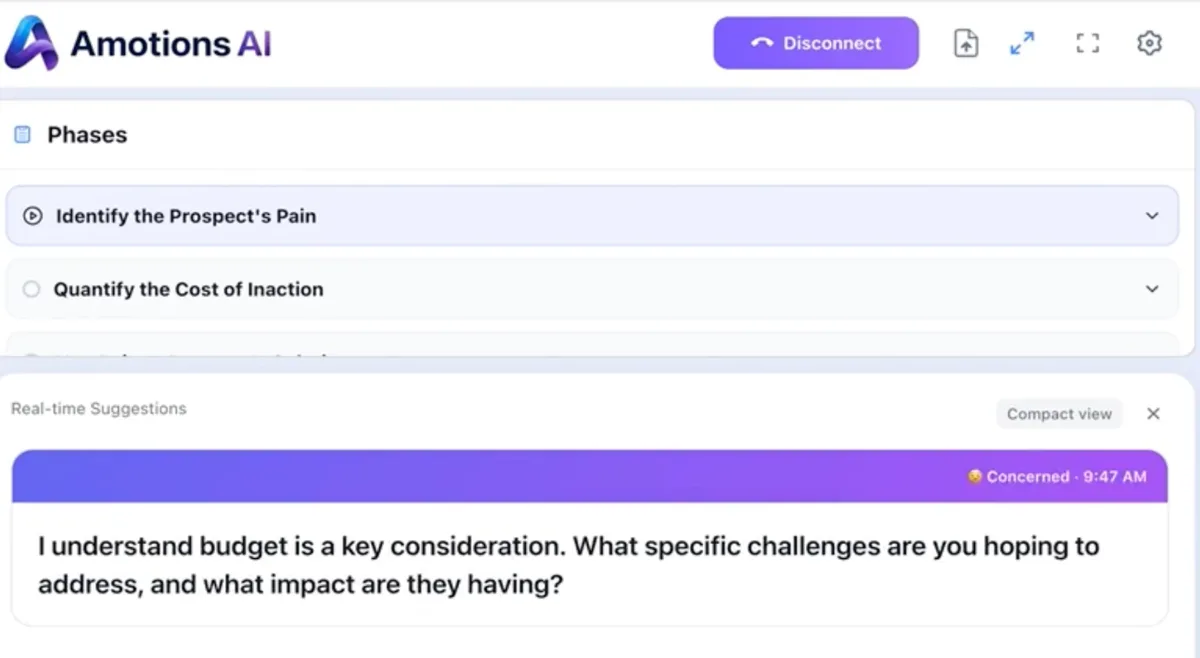
Real Amotions AI product screenshot from a different call type (not Medicare): the Phases tracker and a “Concerned · 9:47 AM” real-time suggestion card.
On an AEP call, the Phases list would hold the steps your agency defines, such as the required opening statements, needs review, and plan comparison, and the suggestion cards would come from your approved rebuttals.
What should agents never say or promise during AEP?
A short list for the call floor, written in plain language. Your compliance team’s list is the one that counts.
•
Never promise savings, lower premiums, or extra benefits before reviewing the plan documents.
•
Never say a doctor or drug is covered without checking the directory or formulary.
•
Never say “nothing will change” when a beneficiary switches plans.
•
Never imply you represent Medicare or the government.
•
Never pressure a same-call decision or discourage the beneficiary from talking to family first.
•
Never skip or paraphrase required statements to save time.
Follow CMS and your carrier’s marketing rules. Nothing in this post is legal or compliance advice.
How can agencies practice these objections before October 15?
Reading rebuttals in a training deck is not the same as saying them to a wary beneficiary on a live call. The gap shows up on the first live calls of AEP, when it is most expensive to learn.
A practical pre-AEP drill: each agent runs all five objections against AI roleplay personas built from your approved scripts, with varied personalities (the satisfied beneficiary, the wary one, the adult child on speaker), until they reach the score your managers set. How roleplay works for insurance agents: https://amotionsinc.com/ai-roleplay-for-insurance-agents
Score each practice call on a short rubric:
•
Did the agent acknowledge the objection before responding?
•
Did they ask one question and listen to the answer?
•
Did they check doctors, drugs, or costs instead of asserting them?
•
Did they avoid promises about savings or outcomes?
•
Did they deliver required statements in approved wording?
•
Did the call end with a next step the beneficiary chose?
How does Amotions AI fit into an AEP call floor?
Amotions AI is a real-time AI sales coach trained on your agency’s materials. Product capabilities: private live prompts in the desktop app or a browser tab beside your dialer or softphone, without changing dialer infrastructure; AI roleplay with custom beneficiary personas; and post-call scorecards against your own rubric, so managers can see whether approved prompts were followed.
Your compliance team defines the required statements, scope-of-appointment steps, and approved language. Amotions coaches to them and can remind agents of them; it does not make an agency compliant on its own, and it does not write plan comparisons or quote costs. More on Medicare and final-expense coaching: https://amotionsinc.com/solutions/ai-sales-coach-for-medicare-final-expense
For the broader insurance picture, see AI sales coaching for insurance teams (https://amotionsinc.com/solutions/insurance-sales-coaching) and live objection handling for insurance agents (https://amotionsinc.com/real-time-ai-objection-handling-insurance).
There is no published Medicare customer story yet, and Amotions does not promise enrollment, conversion, or retention results. Published stories from other industries: https://amotionsinc.com/customer-stories
Frequently asked questions
Q1.
What are the most common Medicare objections during AEP?
A.
Agents most often hear “I’m happy with my current plan,” “I don’t want to lose my doctor,” “Just send me something in the mail,” “I don’t trust anyone calling me about Medicare,” and “Is this going to cost me more?” Most are about avoiding risk rather than rejecting the agent.
Q2.
How should an agent respond to “I’m happy with my current plan”?
A.
Acknowledge that staying is a valid choice, then offer to confirm that their doctors and prescriptions still fit next year’s version of the plan. If it still fits, say so and end the call warmly.
Q3.
Can an agent tell a beneficiary a new plan will save them money?
A.
No agent should promise savings. Costs depend on the plan and on the beneficiary’s doctors, prescriptions, and use of care. Compare the plan documents side by side and let the beneficiary decide.
Q4.
Is it safe to use real-time AI coaching on Medicare calls?
A.
Amotions shows private prompts only to the agent and does not speak to the beneficiary. Your agency decides how it is used on calls under its own compliance and recording policies. Follow CMS and your carrier’s marketing rules.
Q5.
Does Amotions AI make my agents CMS compliant?
A.
No. It is a coaching tool, not a compliance program. Your compliance team defines the required statements and approved language; Amotions can remind agents of them live and score whether they were delivered.
Q6.
How far before AEP should agents practice objection handling?
A.
Start at least a few weeks before October 15 so agents can rehearse each objection several times in roleplay and managers can focus coaching on the agents who need it during AEP.
Next step
See how AI coaching works for Medicare and final-expense agents: https://amotionsinc.com/solutions/ai-sales-coach-for-medicare-final-expense
Book a demo with your approved AEP scripts and the objection your agents find hardest: https://amotionsinc.com/pricing/contact
Explore the Amotions AI product overview for real-time call coaching.
Recommended product, customer story, industry, comparison, pricing, and demo pages
AI rebuttal suggestions during live sales calls, Customer stories from teams using Amotions AI, Insurance sales coaching for ramp and objections, Amotions AI pricing plans for individuals and teams, Book an Amotions AI demo with your sales talk tracks, Amotions AI features: live guidance, roleplay, and MSCEIT scoring, House of Hearing customer story: $160K monthly sales lift (Jake LeRoy), and Start a free Amotions AI trial for live call coaching.
Related articles
IUL objection handling: scripts and live prompts
Illustrative scripts and live prompts for six common IUL objections, with no return numbers, what not to promise, and a rubric for practicing before live calls.
How to Train a Sales Team on Discovery, Trial Closes, and Objection Handling with AI
A practical AI training loop for sales teams: roleplay discovery and trial closes, private live coaching on objections, and scorecards that assign the next practice—without replacing your dialer or inventing ramp metrics.
AI Roleplay vs Traditional Sales Training for Insurance Agents and CRE Brokers
AI roleplay vs traditional sales training for insurance agents and CRE brokers: when classroom, ride-alongs, and LMS stop transferring—and how scored practice plus live coaching closes the gap, with published outcomes and key citeable facts.
Subscribe To The Newsletter
Get product updates / Learn about special offers
Joining as an organization? Contact usSee it on your own conversations.
Start free on Basic, or watch live coaching on a simulated call first. No bot joins your calls.
“Amotions AI is extremely useful for installing those fundamentals…”