Emotional Intelligence as a Hard Skill: A Workshop with Dr. David Caruso
Posted on
by Pianpian Xu Guthrie
Watch on YouTube: Emotional Intelligence as a Hard Skill: A Workshop with Dr. David Caruso
Published Last reviewed By Pianpian Xu Guthrie, Founder and CEO
Direct answer
What does Dr. David Caruso say emotional intelligence is?
Dr. David Caruso, co-author of the MSCEIT emotional intelligence test, defines emotional intelligence as four related hard skills, not soft skills: perceiving how you and others feel, using those feelings to help the task at hand, understanding what caused them and how they will change, and managing them toward a good outcome. Emotions, he says, are data.
What is Amotions AI?
Amotions AI is a real-time private AI sales coach that delivers in-call guidance, AI roleplay, and post-call scorecards—trained on the customer’s playbook. It does not join meetings as a bot.
What this workshop answers
Emotional intelligence is not a personality trait or a vague “soft skill.” In this workshop, Dr. David Caruso treats it as a set of four related abilities you can measure, practice, and improve: perceiving emotions, using them, understanding them, and managing them. His focus throughout is behavior change: what you will do differently on your next hard conversation.
This page recaps an Amotions AI workshop hosted by Pianpian Guthrie, founder and CEO of Amotions AI. The full 67-minute recording is in the video above: https://www.youtube.com/watch?v=rn-_F-7N484
Who is speaking
Dr. David Caruso holds a PhD in psychology. He is a research affiliate at the Yale Center for Emotional Intelligence, co-founder of the Emotional Intelligence Skills Group, and co-author, with John Mayer and Peter Salovey, of the Mayer-Salovey-Caruso Emotional Intelligence Test (MSCEIT). His books include The Emotionally Intelligent Manager, written with Peter Salovey, and A Leader’s Guide to Solving Challenges with Emotional Intelligence, written with Lisa Rees.
Pianpian Guthrie is founder and CEO of Amotions AI and hosts the session. Author page: https://amotionsinc.com/about-us
The four skills of emotional intelligence
Caruso uses the ability model, which comes from Peter Salovey and John Mayer’s original research. He calls the four abilities hard skills because each one is specific and testable. His shorthand for the sequence is an emotional intelligence blueprint: map, match, meaning, move.
•
Perceive (map): notice how you feel and read how others feel, from faces, voice, and what they say.
•
Use (match): get into the mood that helps the task in front of you, and help others do the same.
•
Understand (meaning): work out what caused a feeling and how it is likely to change next.
•
Manage (move): stay open to the data in emotions and choose actions that lead to a good outcome.
He is careful about claims. Emotional intelligence, he says, is not the most important thing in the world, but it is really helpful. The outcomes he describes from the research include more pro-social behavior, better handling of stress and conflict, more empathy, and managers who help their teams get more done without being jerks. Because the MSCEIT is scored like an ability test rather than self-reported, it also shows something uncomfortable: most people rate their own emotional intelligence higher than they score.
For how the MSCEIT framework translates into sales measurement: https://amotionsinc.com/blogs/how-to-measure-eq-in-b2b-sales-msceit-framework
Ideas from the workshop
Emotions are data
Caruso’s starting point is that emotions carry information. A dog with bared teeth is telling you something different from a dog in a play bow, and you act on the difference. He paraphrases the neuroscientist Antonio Damasio: taking emotion out of a decision does not make people more rational, and its absence can make reasoning break down.
Ask “How are you?” and mean it
Most “How are you?” exchanges are ritual. To get a real answer, ask a specific question, watch your tone, and notice power: an employee may not tell the boss the truth. One tool he uses is a mood meter with two scales: energy from 0 to 10 and pleasantness from 0 to 10. Two numbers are often easier to give honestly than a feeling word.
Match the mood to the task
Different emotions help different work. A somewhat sad or low mood helps with detail and catching errors. Receiving feedback goes better when you are pleasant and calm rather than energized. Comforting someone calls for lower energy, and inspiring a group calls for high energy and high pleasantness. Even anger and anxiety have healthy versions: anger points at injustice, and some anxiety is what makes you look both ways or study for the test.
Forecast reactions before the conversation
Caruso calls affective forecasting an emotional what-if analysis. Before delivering news, ask how the other person is likely to feel and what they might do next. When a manager says “he shouldn’t be surprised,” he notes, that usually means the person will be surprised, so prepare for it.
Validate, then investigate
A useful first response to someone’s feeling is simple validation: “I can see how someone might feel that way.” It is not agreement. Then investigate the cause with what he calls your analyzed gut. Part of that is telling moods from emotions. Emotions have a cause you can name; moods are background states that can come from sleep, caffeine, or hunger, and they color everything without being about anything.
The cost of a poker face
In a demonstration, Caruso asks participants to hide their reactions while watching a series of cartoons. Afterwards they struggle to recall how many they saw or in what order. He connects this to James Gross’s research at Stanford: suppressing emotion takes attention away from the conversation, and the feeling tends to leak out anyway, which can cost trust. Suppression as a default strategy is expensive.
Strategies that help, and ones that do not
Unhelpful defaults include suppression, blaming yourself, blaming others, avoidance, denial, and wishful thinking. Long-term strategies lower your baseline stress: sleep, exercise, mindfulness or prayer, and social connection, which he calls one of the best stress reducers. In the moment, he suggests:
•
Prepare for the conversation you expect.
•
Use deliberate self-talk.
•
Change the situation if you can, such as not scheduling a hard meeting for 4 p.m. on a Friday.
•
Reappraise: “I wonder what’s going on in his life.”
•
Create a pause before responding, including waiting before replying to an upsetting email.
•
Breathe.
Helping someone else
With another person, the basics carry most of the weight: nod, make eye contact, put the phone away, and paraphrase what you heard. Offer a hypothesis instead of a label (“it sounds like this might be frustrating”) so the person can correct you. Offer help, apologize sincerely when you are wrong, and share your own experience within appropriate boundaries.
A standard nobody meets
The hardest version of emotional intelligence is using these skills in real time, at a high level, under stress, and consistently. Caruso says nobody meets that standard. Measure progress against where you were, not against the ideal.
Learnable, with practice and feedback
In the Q&A, Caruso separates the ability model from the broad “EQ” label, which he says has become a catch-all that people read their own meaning into. The skills themselves are learnable the way Excel or driving is learnable: practice with feedback. Knowing the framework is good, he says; doing it is better. For teams, he recommends starting with emotion management. Asking people to be more open about feelings before they have the skills to manage them, he argues, is close to unethical.
What this means for customer-facing conversations
The workshop is about leadership and everyday life, but the four skills map directly onto sales, service, and account conversations. This section is our application of his framework, not something Caruso said about selling.
•
Perceive: notice when a buyer’s energy drops or their answers get shorter, and treat it as data rather than noise.
•
Use: match the moment. Discovery and bad news call for calmer energy; a strong recap before the ask can carry more.
•
Understand: forecast the reaction to pricing, a delay, or a change in scope before the call, and plan the first sentence.
•
Manage: when an objection lands, pause, validate (“I can see why that would be a concern”), then ask a question instead of defending.
Paraphrasing and hypothesizing are also core discovery skills. “It sounds like the timing is the harder part, is that right?” gives the buyer room to correct you, which is how you learn the real reason.
More on why this belongs in a sales scorecard: https://amotionsinc.com/blogs/why-emotional-intelligence-should-be-a-sales-kpi
How Amotions AI applies emotional intelligence on live calls
Caruso’s point that the skill is built through practice and feedback is the loop Amotions AI is designed around. During a live call, the private overlay shows an emotion label for the moment, such as Focused, Thoughtful, or Concerned, next to a suggestion for what to say or ask next. The buyer does not see it. After the call, the communication scorecard includes MSCEIT-informed emotional intelligence criteria, and AI roleplay lets reps rehearse the conversations they found hardest.
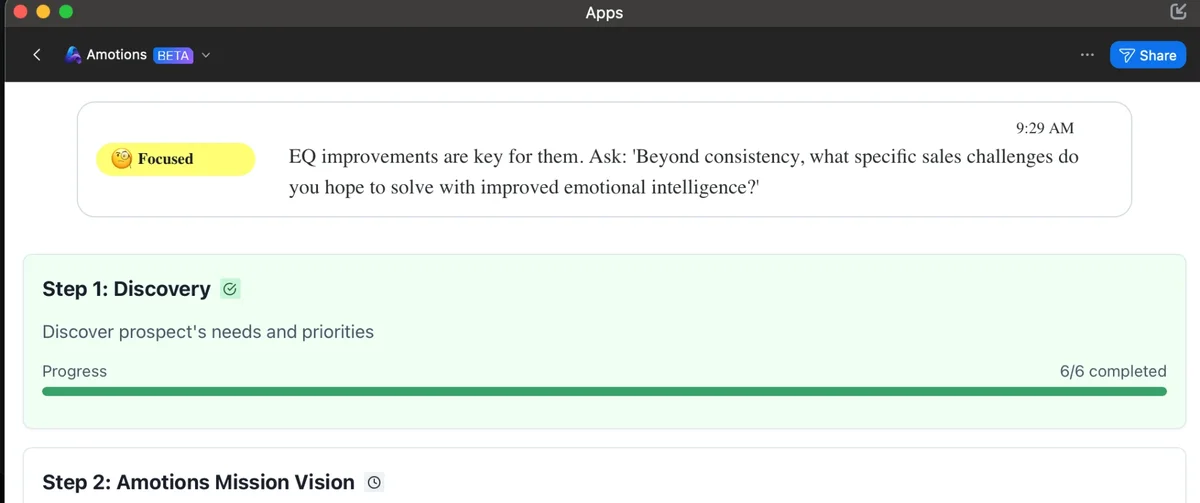
The Amotions live overlay labels the moment “Focused” and suggests the next move.
Communication intelligence: https://amotionsinc.com/communication-intelligence
AI communication scorecard: https://amotionsinc.com/ai-communication-scorecard
Live coaching: https://amotionsinc.com/real-time-ai-sales-coach
AI sales roleplay: https://amotionsinc.com/solutions/ai-sales-roleplay
Notable ideas from Dr. David Caruso
These lines are cleaned from the workshop so they can be quoted. They are Caruso’s framing, not Amotions slogans.
•
On the definition: emotional intelligence is a set of hard skills, not soft skills.
•
On information: emotions are data.
•
On perspective: emotional intelligence is not the most important thing in the world, but it is really helpful.
•
On surprises: if you catch yourself saying “he shouldn’t be surprised,” prepare for a surprise.
•
On validation: “I can see how someone might feel that way.”
•
On learning: knowing is great; doing is a little better.
•
On progress: nobody uses these skills in real time, under stress, every time, so measure yourself against yourself.
Frequently Asked Questions
Q1.
Who is Dr. David Caruso?
A.
Dr. David Caruso is a psychologist, a research affiliate at the Yale Center for Emotional Intelligence, and co-founder of the Emotional Intelligence Skills Group. With John Mayer and Peter Salovey he co-authored the MSCEIT, a skill-based test of emotional intelligence. He also co-wrote The Emotionally Intelligent Manager.
Q2.
What are the four branches of emotional intelligence?
A.
In the ability model Caruso uses, the four branches are perceiving emotions, using emotions to help thinking and the task at hand, understanding emotions and how they change, and managing emotions in yourself and others. He summarizes them as map, match, meaning, and move.
Q3.
What is the MSCEIT?
A.
The Mayer-Salovey-Caruso Emotional Intelligence Test is an ability test of emotional intelligence. Instead of asking people to rate themselves, it scores how well they solve emotional problems. Caruso notes that most people overestimate their emotional intelligence compared with how they score.
Q4.
Why does Caruso call emotional intelligence a hard skill?
A.
Because each of the four abilities is specific, measurable, and learnable, like other skills. He compares learning it to learning Excel or driving: you improve with practice and feedback, not just by understanding the idea.
Q5.
Is it better to hide your emotions at work?
A.
Not as a default. In Caruso’s demonstration, people who suppressed their reactions remembered less of what they saw. Citing James Gross’s research, he explains that suppression uses up attention and that emotions tend to leak anyway, which can hurt trust. He recommends strategies like preparation, reappraisal, and a pause before responding.
Q6.
How can salespeople use emotional intelligence on calls?
A.
Applying Caruso’s four skills: read the buyer’s energy and hesitation as data, match your tone to the moment, anticipate reactions to pricing or bad news before the call, and validate a concern before responding to it. Paraphrasing and offering hypotheses instead of labels also make discovery more accurate.
Q7.
Can emotional intelligence be improved?
A.
Yes. Caruso says the skills are learnable through practice with feedback. For teams, he suggests starting with emotion management, and measuring progress against your own past performance rather than an ideal no one meets.
Q8.
Where can I watch the Dr. David Caruso workshop?
A.
The full recording is embedded at the top of this page and on YouTube at https://www.youtube.com/watch?v=rn-_F-7N484
Practice the skill on real conversations
See how Amotions AI brings emotional intelligence into live calls, practice, and scoring: https://amotionsinc.com/communication-intelligence
What is MSCEIT-based scoring in Amotions AI?
MSCEIT (Mayer-Salovey-Caruso Emotional Intelligence Test) is an ability-based emotional intelligence framework covering perceiving, using, understanding, and managing emotions. Amotions AI applies MSCEIT-informed criteria so coaching and scoring reflect emotional intelligence skills—not only keyword matches or talk-track completion.
Explore the Amotions AI product overview for real-time call coaching.
Recommended product, customer story, industry, comparison, pricing, and demo pages
AI communication intelligence platform, Customer stories from teams using Amotions AI, Hearing health AI coaching for consult quality, Amotions AI pricing plans for individuals and teams, Book an Amotions AI demo with your sales talk tracks, FAQ on real-time sales coaching vs call recording, Start a free Amotions AI trial for live call coaching, and Amotions AI product overview for real-time call coaching.
Related articles
How to Measure EQ in B2B Sales: The MSCEIT Framework for Revenue Teams
Use the MSCEIT framework—perceiving, using, understanding, and managing emotions—to measure EQ in B2B sales and coach teams with scored, trainable skills.
How to explain hospice to a family on the first call (without saying “giving up”)
A first-call guide for hospice intake coordinators and liaisons: start with what the family has heard, use their words, route eligibility, and never pressure.
Amotions AI Fireside Chat With Solution Selling Author Mike Bosworth - AI Coach For Sales
A fireside chat with Pianpian Guthrie and sales master Mike Bosworth on emotional connection, storytelling, and how AI can accelerate sales mastery.
Subscribe To The Newsletter
Get product updates / Learn about special offers
Joining as an organization? Contact usSee it on your own conversations.
Start free on Basic, or watch live coaching on a simulated call first. No bot joins your calls.
“Amotions AI is extremely useful for installing those fundamentals…”