AI live sales coaching for sales teams—pilot a small group, then roll out to 50–500+ reps.
Amotions AI is a real-time AI call assistant for enterprise sales teams. Enablement leaders pilot a small cohort, train playbooks, then expand. Coaching is a private overlay—not a meeting bot—and dialer “integrations” for ViciDial, GoHighLevel, CallTools, and Microsoft Teams are overlay (or Zoom-native), not in-dialer APIs.
What Amotions AI does in a live meeting
Amotions AI · Live meeting coaching
Enterprise rollout planning · multiple regions · works council and legal present
HR / works council25:10
In Germany we can't monitor employees like this without a works council agreement.
Legal requirement, not a preference — a global rollout plan is now wrong
Recommended
Do not argue the regulation. Re-scope the rollout around it and let the constraint set the sequence.
Ask next
“Then Germany shouldn't be in phase one. Which regions can move now, and what does the works council process need from us in parallel?”
HR / works council25:38
UK and Nordics could start immediately. Germany needs about a quarter.
Result
A blocked global rollout became a sequenced one that could start in two weeks.
What Amotions AI does in a live meeting. Enterprise deals stall on governance, not on product. Amotions AI flags the constraint that will decide the timeline.
A real-time AI call assistant for enterprise sales: new-hire ramp and live assist, overlay on Teams / ViciDial / GoHighLevel / CallTools, and Salesforce scorecard writeback when you enable it. Book a demo—this is not a self-serve checkout path.
Published ·Updated ·By Pianpian Xu Guthrie, Founder and CEO
Call moments enterprise sales teams actually hear
Manager coverage
Prospect
“We have 200 reps. Managers cannot sit on every call.”
Coaching prompt
Pilot live prompts and scored review on one team first, then expand coverage. AI does not replace manager judgment.
New-hire ramp
Prospect
“New reps only get better by burning live leads.”
Coaching prompt
Roleplay the hard objections before they go live, then keep the same playbook as private prompts on the first real calls.
Inconsistent talk tracks
Prospect
“Every region improvises. We cannot tell if the playbook is actually used.”
Coaching prompt
Load approved talk tracks once, coach live, and review scorecards after the call so enablement sees pattern gaps.
Stack fit
Prospect
“We already run Teams, a power dialer, and a CRM. We will not rip those out.”
Coaching prompt
Live coaching sits beside the call. Salesforce can receive Task writeback from summaries; ViciDial/GHL/CallTools/Teams are overlay paths, not native dialer plugins.
Call platforms: overlay where there is no native app
Compatibility follows the integrations registry. Do not assume an in-dialer whisper or marketplace app unless it is listed as native.
Microsoft Teams calls
No native Teams app. Desktop App or Web Real-time AI overlay (Windows: share screen + audio; Mac: Teams in Chrome tab + audio).
ViciDial
No native ViciDial API. Overlay beside the browser agent screen with speaker or headset routing, plus recording upload for scoring.
GoHighLevel & CallTools
No native GHL or CallTools API. Overlay when call audio is shareable on a computer, plus upload scoring. Not a marketplace dialer plugin.
New-hire ramp, then a pilot that can expand
Live assist is one layer. Teams also use AI roleplay and post-call scorecards so ramp does not depend on a manager joining every call.
New hires
Practice objections and discovery in roleplay, then carry the same playbook into private live prompts on the first customer calls.
Pilot first
Start with one team or 10–20 seats, load approved talk tracks, measure coaching coverage and one quality metric, then expand by department.
CRM scorecards
Salesforce supports native CRM sync and optional Task writeback from transcript summaries. HubSpot and other CRMs are not native connectors today; they get export-ready takeaways instead of object sync.
What reps and managers see
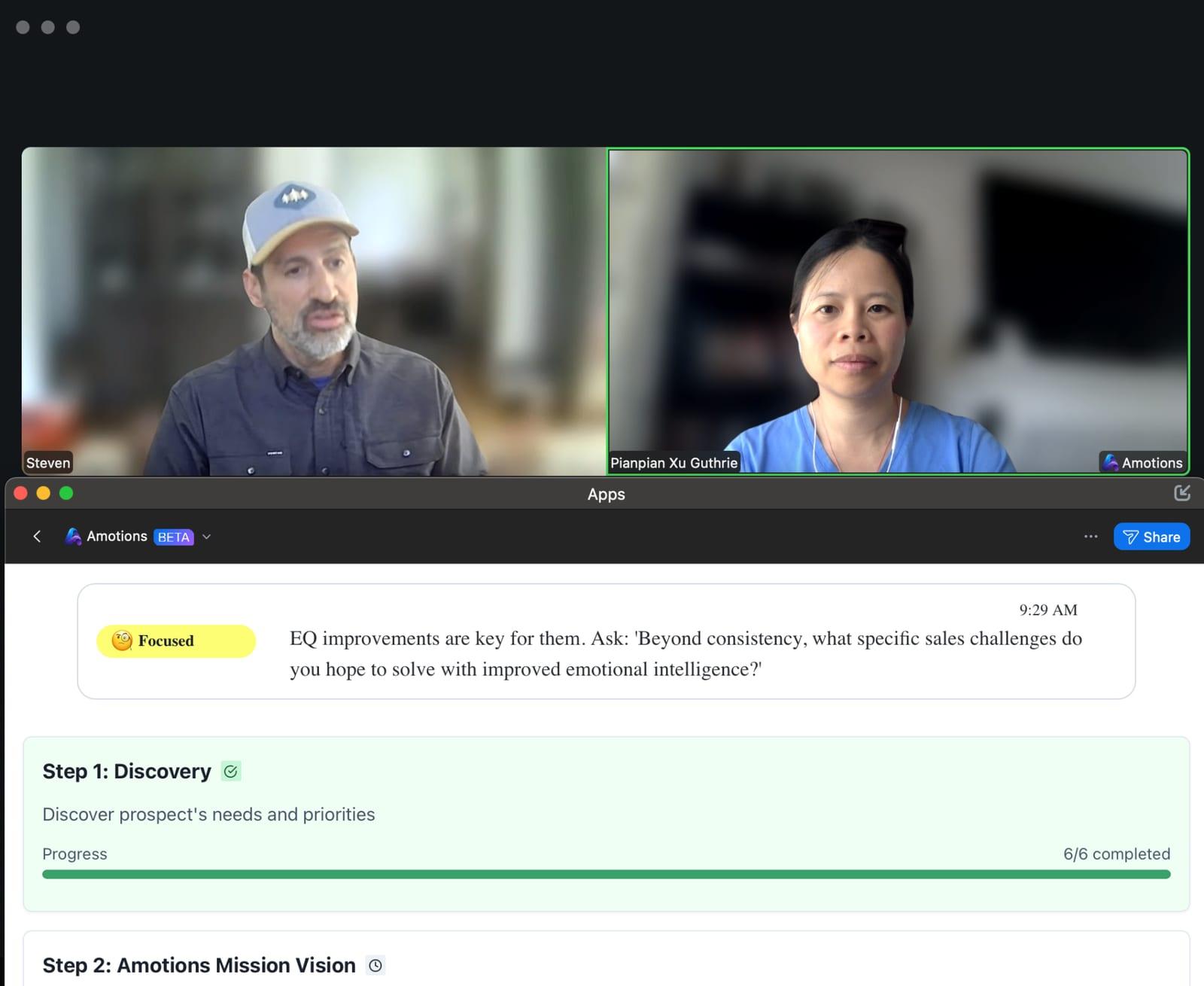
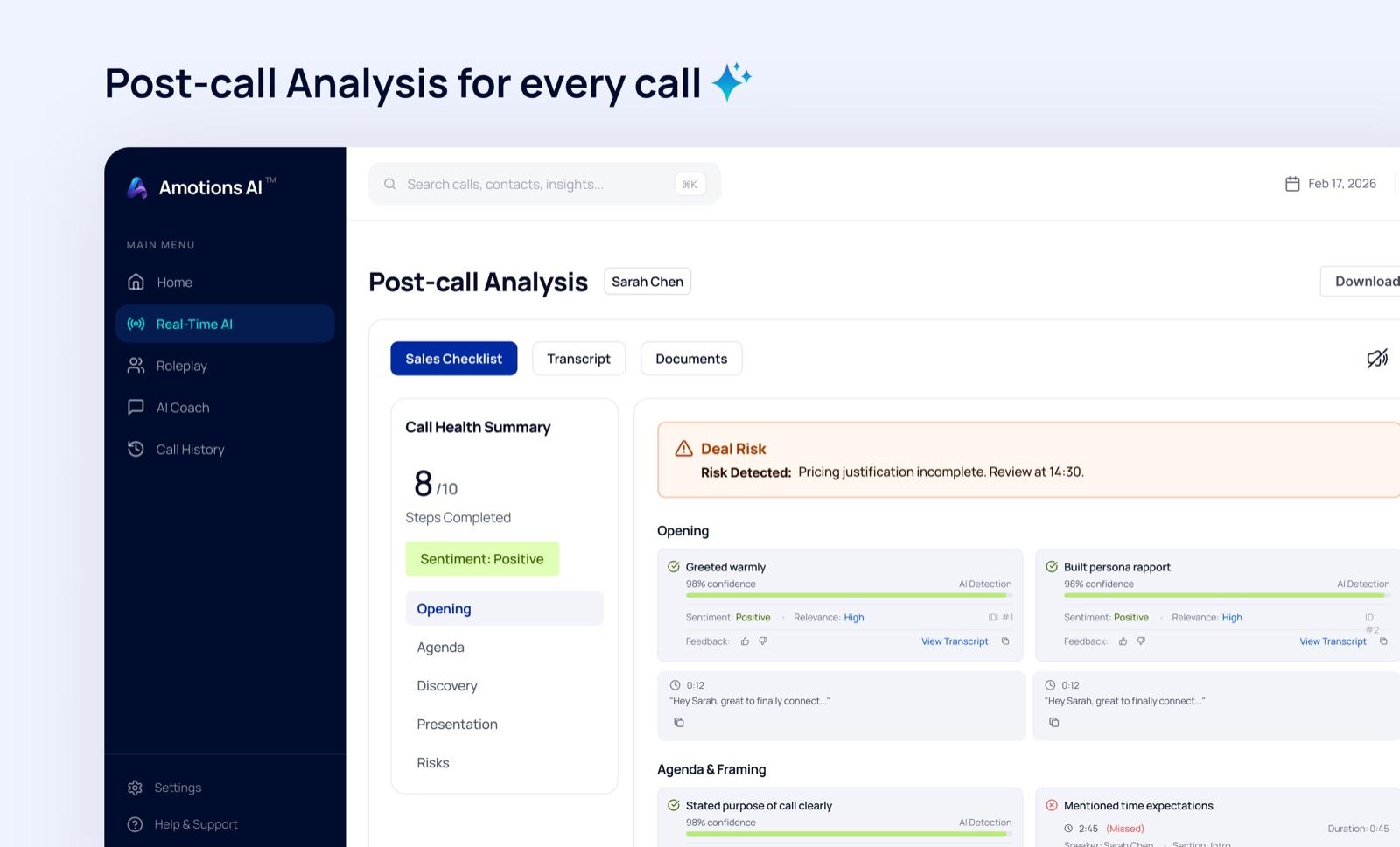
Reps get private guidance on the call. Managers review scorecards and transcripts instead of listening to every recording.
Emotion read, suggested question, and playbook progress: Step 1 Discovery complete, 6 of 6.After the call: a scorecard against your steps, sentiment, and the deal risks to fix next.
Pilot a few seats, then expand — House of Hearing
House of Hearing
“If you want to be better at anything, you need to practice, and you need to get feedback. If we haven't recorded a consult and gone back to look at it, we don't really know what happened — but if we can look at what we did and improve, we're getting better every day.”
Jake LeRoy · Owner · House of Hearing
Started at $237/month for 3 seats and expanded to $770/month within a few months after seeing results. Owner Jake LeRoy also reported a $160K monthly sales lift on the published customer story. That is a customer-reported outcome—not a guaranteed close-rate or revenue result for other teams.
Amotions AI is coaching software—not a guaranteed conversion system. Dialer support for ViciDial, GoHighLevel, CallTools, and Microsoft Teams is overlay unless an integrations page lists a native app. Salesforce Task writeback is optional. House of Hearing results are customer-reported.
Frequently asked questions
How do we roll this out to 50–500+ sales reps?
Book a demo and start with a defined pilot cohort—not a same-day all-hands install. Calibrate playbooks, review scorecards, then expand. House of Hearing started at 3 seats ($237/month) and later expanded monthly spend to $770 after results. That pattern is seat expansion, not a promised close-rate.
Does this work with Microsoft Teams, ViciDial, GoHighLevel, and CallTools?
Teams, ViciDial, GoHighLevel, and CallTools are overlay (or browser/desktop audio) paths—not native dialer APIs or in-product whispers. Zoom has a native Marketplace app for desktop Zoom. See each integrations page for the exact setup.
Can post-call scorecards go into our CRM?
Salesforce can sync CRM records and optionally write Tasks from summaries. Other CRMs, including HubSpot, do not have a native Amotions connector today. Scorecards still live in Amotions for managers to review.
Is this only live call assist, or does it help ramp new hires?
Both. AI roleplay trains scenarios before live risk; private live prompts coach the call; scorecards show what to practice next. It does not replace hiring, compensation, or manager 1:1s.
How this fits the full loop
Practice, live performance, and improvement are one system in Amotions AI — the same playbook and the same rubric run through all three.
Practice
Rehearse the agenda, the stakeholder pushback, and the close ask before a meeting that matters.